
Albert "Mantis" Theodore
1945-1991 - A biographic introspective - [ Alternate History ]

Part One - A Lost Era
Albert Theodore was born in Elizabeth, New Jersey, on the third hour of July the 12th, 1945. His parents were Alexander Theodore, the son of an immigrant from Crete, and Jane Morrison, the daughter of a farmer who moved from rural Pennsylvania to work in war factories. Alexander worked as a train conductor and was spared the draft and the horrors of the Pacific during the battles fought against Japan. Not much is known of their relationship with their son, but Albert never spoke ill of them later in his life. Growing up in Staten Island, Albert used his natural strength to win fights and games against other boys during his school years, which landed him with reprimands and suspensions during his education over behavioral concerns. He was even arrested as a juvenile for sending another young man to the hospital in 1959. While academically advanced, especially in terms of mathematics, he was unable to find a college that would accept him or let him stay for long, due to his history and supposed anger-management issues. Realizing the poverty hitting his community after the economic booms of the 1950s dried out, the athletic man decided to enroll in the West Point Military Academy, hoping to find a career that would set him on a straight career path. Joining in 1963, Albert graduated with average grades, just in time to be assigned command of a tank platoon serving in Dak-To, Vietnam. The unit was sent in to replace a previous unit that had suffered major casualties. Sent into the violent and fiery jungle of Vietnam straight from boot camp, the company faced major attacks in 1967. Albert focused on keeping his soldiers safe due to the increasing boldness of the Viet Minh occupying most of the country and their Kenestik/Chinese suppliers which handed them almost equivalent weapons. During a Vietnamese offensive into the town, Viet Minh soldiers overran the base, burning down the French-built mansion that was serving as an Army headquarters for the area. Albert’s M48 Patton Tanks used their heavy firepower, disobeying orders to guard the southern portion of the town, to lay down suppressive salvos. Albert himself moved up with a platoon to shield U.S Army medical evacuation helicopters and prevent them from being overwhelmed by small arms fire.
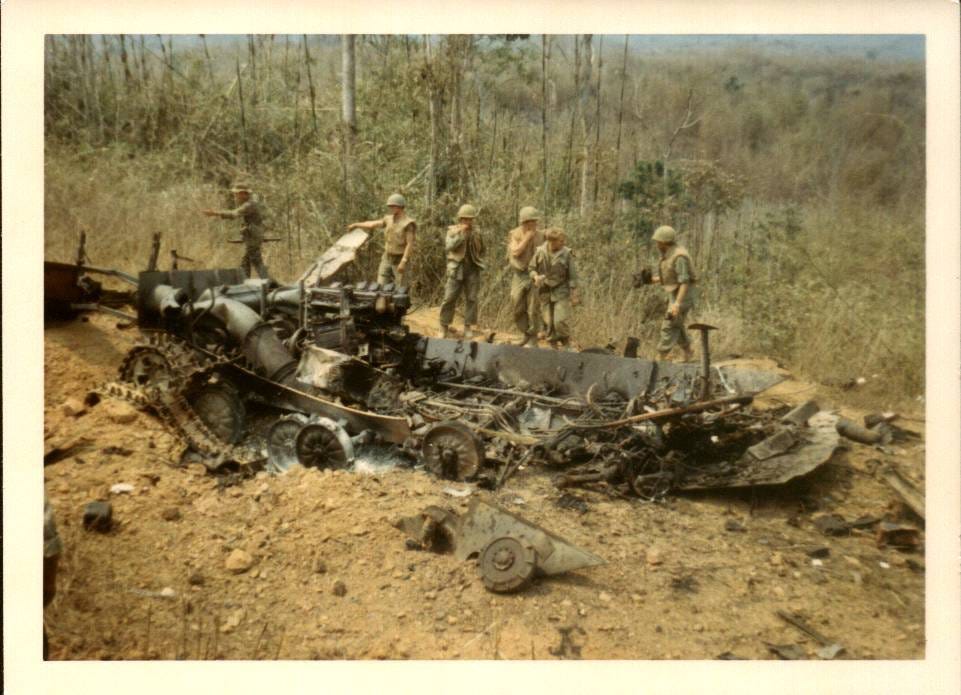
For his actions at Dak-to between 1967 and 1969, Albert was promoted from Lieutenant to Captain, which eventually placed him in a metaphorical desk-job. He spent 4 years of the war facing almost no combat at all, sitting atop an M48 beside an American government office built along the coast. Watching planes land and take off from the nearby airport, Albert was dismayed. The war in Vietnam was dragging on, and America was focusing on pummeling Vietnamese with the air force. Tanks barely got to move, and when they did, it was not Albert’s company. He found it extremely banal to talk with other officers, spending most of his time alongside the enlisted tankers of his unit. Despite the lack of combat, Albert found himself getting promoted more and more for “just sitting still” (his own words). This period of time did give Albert a lot of spare hours to just think, and Albert wrote frequently in a journal, which detailed both his thoughts on life at certain points in time, and significant experimentation with military tactics based on tank maneuver warfare.
By 1976, he was an O-5, a full-fledged lieutenant colonel, having been then transferred to defend Da-Nang’s air base from consistent guerilla attacks and move to deploy infantry in search and destroy (SEAD) missions in the surrounding areas that were not cleared by Agent Orange. In this late-war stage, Albert commanded an entire brigade of Army servicemen and a battalion of tankers. which tore him out from the initial attachment he had to his soldiers. His aide reported that by 1977, he had become colder and was much more withdrawn. This could also be an effect of the war’s status - It had lasted for far longer than anybody had expected, and while American forces had control over everything south of Da-Nang itself (and had even landed Marines by the Gulf of Tonkin to open up an invasion path into Hanoi proper), everyone began to wear out. Albert had only gotten the opportunity to rotate out for a few months in 1973, and he had missed the American lifestyle. Vietnam was a hellish nation, now thoroughly cleansed of wildlife through sheer bombardment and chemical action. Bodies piled up on both sides, and the landscape became gray, the skies over Da-Nang always clouded. The Viet Minh and other communist forces were losing, with the USKR cutting support and pulling out their advisors in 1975. This made the Vietnamese even more desperate, and they began to enact radical approaches to terrorizing Americans on the ground. Albert survived a large assault by Vietnamese soldiers in the December of 1977, the penultimate of all attacks on Da-Nang, which cost him seven M48 tanks, either destroyed by enemy rockets, disabled by suicide bombers, or lost in the swamp. Despite casualties, Albert’s unit, the 1st Battalion 69th Armor, held the line until reinforcements relieved their position and hunted down the Viet Minh, securing a decisive victory. One of Albert’s journal entries, later published by the L.A Times, talks about him inspecting the enemy infantry that had become prisoners, captured from this battle - “Sickly young children, half of them girls, alongside the more professional PAVN. They had been brought to serve as cannon fodder for the attack, to help the real gook soldiers overwhelm us by eating up bullets. Many of them had only brought pistols, civilian shotguns, some even only carrying melee weapons. I thank God that my enemies are so weak.” Albert later rotated out in the summer of 1978, now promoted to the rank of Major General. He landed in California with his battalion, enjoying down time as he prepared to lead again the following year.
With the war becoming bogged down during the Siege of Hanoi, instability was rife in the political sphere back home. Especially violent and prevalent were separatist groups - Confederate, Socialist, Syndicalist, or Nationalist, they all wanted to tear apart the current American Empire because of the government’s failures and overreaches. A massacre by Socialist paramilitary groups, and the messy 1978 election, started a chain of events that eventually boiled over into a full-on civil war, primarily in the Deep South, Texas, and major cities in the East Coast. Black supremacists and Socialist paramilitary cells organized themselves into a unified military force, and started seizing states. They burned down Federal government offices, subdued any guardsmen or federal agents that wouldn’t collaborate with them, and started a vengeful looting campaign against people amongst them who did not support their parties. Most of these were uninvolved White Americans, who then became radicalized after undergoing the “Red Terror”. The solution for these newly destitute refugees forced out of their homes was clear: To join the burgeoning and defensive Ku Klux Klan. The Klan had used the instability to build their own armaments, and began to form militias all across the south, dedicated to defending their towns and cities, since it was clear the Federalist forces were unable or unwilling to help their southern counterparts against the rebels. The Federalist forces being the collective of all federal agencies and services mobilized to provide an army against the revolution, organized by Washington D.C.

Part Two - Pained Return
During the period of time before the outbreak of war, Albert moved himself to Carlsbad, spending long periods in a rented beach house property. He saw the constant stream of military paperwork as diminutive and useless. Most of his time during those few months are only known thanks to Sergeant Daniel Ethelred, the colonel’s aide and the head of his security staff. Sgt. Ethelred was a devoted infantryman, and he had actively sought to join as a guard for high-ranking officers in the hope he could advance his career. Disappointingly for Ethelred, Albert was not overly professional in his behavior. He got drunk on spirits often, rambling on about Vietnam war policy, welcoming meetings in the lower floor of the house with his uniform improperly made. Usually, he never even wore his official colonels’ uniform, opting for his tiger stripe pattern tunic instead because of the heatwave occurring that summer. He stopped shaving after the first week and instead opted to grow a full beard, which often went untrimmed. The soldiers there to guard him, often stood for hours behind the door of his office, instead of posted by the entrance as they should have been. This is because Theodore hated seeing the faces of humans, regularly ordering the sergeant and his other infantrymen to stay outside when he focused on writing, reading, enjoying the day, and especially when he invited friends from his unit over. Ethelred writes that specifically, Albert hated seeing the face of a Hispanic soldier within the unit, accosting and mocking the man often with his friends. It got so bad that once, the soldier interrupted Albert to give him an important memo, and in response Albert punched the man in the face. A few days after that, Ethelred took initiative and transferred the soldier out by his own accord. Expecting Theodore to reprimand him, he was actually congratulated by the Colonel, who would later write a letter of recommendation for Ethelred in response. Worst of all in the eyes of Ethelred, was the Colonel sneaking out without his guards’ knowledge to try and meet people or have fun with his military friends in nearby taverns and similar locations across Carlsbad. Sgt. Ethelred almost raised an entire-state-wide alarm, assuming the Colonel had been kidnapped, only for him to show up at 6 A.M, hungover with light bruising across his face. One major incident that Ethelred was forbidden from speaking about was the alleged rape of an unnamed woman in the Carlsbad area, whom he had invited to his house after meeting her at one of these locations. Albert Theodore never connected with women his entire life, seeing as his youth was spent at West Point and in the jungle. The woman, initially charmed by the high-ranking officer, refused his advances once he brought her to his Carlsbad home. Apparently finding it strange that a 28-year-old woman had come so far just to reject him, Albert either thought she was goading him or became angry at her attempt to leave. Ethelred and several other off-duty guards were awoken, coming up to find the two on-duty guards standing outside the door, with orders from the Colonel not to come inside the office. Not willing to risk losing his career, Ethelred ordered everyone to forget about it, spending the night smoking cigarettes with his soldiers as they complained and debated their future action. In the morning, the soldiers only saw a glimpse of the woman as a chartered taxicab took her away early, and the Colonel ordered everyone to forget about it.
Part Three - The Call for Action
This course of events ended in 1979, when the violence in the South became so accelerated that the United States Government ordered the creation of the Federalist Army mentioned earlier. Hearing the news, and realizing that his tank regiment was one of the only tank forces inside the continental United States, Theodore jumped at the opportunity to become one of the first leaders for the Federalist Army. Three days after Washington D.C’s memo, Theodore moved out of Carlsbad and reorganized his unit. This was difficult to do as many had dispersed, expecting their rotation out of Vietnam to last for two more weeks until they had to return. Gathering all the men he could, Theodore took charge of a Californian mobilization center. Splitting the newly ordered draftees from California into three different regiments overnight, he divided up the tank forces he could create into three separate combat teams, hoping for them to lead the charge in battle against the rebel-held towns they were planning to attack. Officially, they were the Federalist 2nd Infantry Division (split into three brigades), but the soldiers nicknamed the unit “Theo’s Brood” due to how many of the soldiers had served under his command, and his fiery speeches given as many times as Albert could fit into the schedule. Albert was focused on creating fighting spirit amongst the draftees especially, knowing that most of them were either young and fearful or old and scorned, sternly against their lives being upended by this duty. Some reservists mutinied in the first few days of being handed a rifle, with Albert’s veteran Vietnam soldiers in short supply to maintain discipline. Theodore was also constantly hammered by Federalist authorities who wanted him to hold out on moving all his troops out east, hoping for Congress to put in a peace proposal before things turned worse. Albert vehemently disagreed, as reports of the united rebel bloc, forming their own conventional armies broke through unofficial channels and into his ears. Another delay within Albert’s plan was caused by a group of Libertarian and Socialist terror cells trying to start an insurgency in the northern rurality of California, terrorizing farmers. He had to split a chunk out of his already shoestring budget and undermanned, and had to also find a capable officer to lead the men in their SEAD mission against these infiltrators. A vital few AC-47 gunships and UH-1 helicopters were also given up, much to the dismay of the Colonel who wanted as many fire support assets to come with him as he could bring. Before leaving California, the President himself promoted Theodore to the rank of a major general. By early spring of 1980, the force set out for the battlefield that the former Confederacy, Midwest, and East Coast had become in the fallout of civil conflict.
The official destination of the trains, trucks, and aircraft heading East was Orlando, Florida, but Albert knew he had to take action in Oklahoma, Tennessee, and then choose to either head south to aid Alabama or take back Indiana. Despite struggles in Arizona, he made it through, even past the Indian reservations without extreme difficulty. On the march through New Mexico, several dozen soldiers deserted, committed suicide, or suffered heatstroke related injuries due to the lack of water available. Others died from accidents, being lost in the desert mesa, or because they attracted wild creatures in the night. The arduous campaign was marred by protests in Albuquerque, where once the army had expected relief. People did not enjoy military vehicles tearing up their streets, and the death of a young Hispanic child at the hands of an M52 self-propelled howitzer riding along the Federalist forces inflamed the local Mexican community.
The mother of said child was later arrested and executed by hanging during the 2FID’s stay in Albuquerque, Albert having her found guilty of “criminal negligence” and ”manslaughter”, stating that she was responsible for letting her child run in front of moving armored vehicles. Normally this sentence would warrant a far lighter punishment, but under Martial Law, Theodore had no restriction on the sentence he could put into play. This action only made the locals angrier, and one man even died trying to attack Federalist soldiers with a homemade petrol bomb, failing to activate the device before he was gunned down in the street by riflemen. Hotels refused service, and several local families had to be pressured to give up room for the soldiers. With how much the people hated them, Federalist soldiers saw it fit to abuse the people. One soldier was famously photographed groping and then beating a young woman in a roll of film taken from bystanders. Soldiers barging into “richer looking” houses to loot valuables was not unheard of. Theodore did not punish any soldier during their stay at Albuquerque for any stated crime, and this actually ended up winning him the support of many fresh-faced officers, seeing him as their loyal leader after leaving.
The force continued on their movement, next heading for Amarillo, Texas. This is where they would first see combat, as a Neo-Confederate militia group right outside the city attempted to derail the leading train and ambush the escorting soldiers. Luckily they were spotted by scouts early on, and the train carrying a OH-6 Cayuse helicopter lifted up and ahead to gun down the militants and take out the derailment devices ahead of the train convoy. The remaining militants fled, and were hunted down by soldiers who performed searches across the town. The town was considered under Federalist Occupation, though this time Albert took his time to order a no-looting rule. The captured militants were not executed, as Theodore’s hope was to rally any possible groups against the socialist rebel bloc, even if they were separatists themselves. He offered them control back over their town as long as they swore allegiance to the Federalist cause and swore to defeat any socialist insurgents heading this way. Reluctantly, the defeated militia men and women of Amarillo accepted, even after having 28 of their own killed by the now 18,600 number understrength military force. Albert also commandeered food and supplies from the locals afterwards, solving the dehydration issue.
Theo’s Brood advanced onto Oklahoma City in the morning hours of August 12, 1979. The town had been attacked by Socialist infiltrators and sympathizers, but the local militia and police department had quelled the insurgency quickly with support from the populace. Under D.C’s order, the local authorities had united to form a security force, officially designating themselves the 27th Federalist Mobile Infantry Brigade, 2,300 men, most of them middle-aged and out of shape, had spent their time lynching suspected rebels and minorities, building up their small force for the war ahead. Under their possession was a fleet of 104 pickup trucks, modified with a standard set of steel plates protecting the engine block and cabin, giving them a sort of “armored personnel carrier” to enforce their law in the region. Arriving and welcomed without hostility, the two Federalist armies enjoyed rest and recuperation. In agreement, the 27th FIB would join the 2nd FID in the march east, the women of the city taking over guard duty for the most part. Things would be harsh with 1/3rd of the city’s male population gone at this point, however Theodore convinced the people that it was necessary to fight in this national struggle, even at the cost of their livelihoods. The forces left for Arkansas in late November, as they waited for more supplies to join them and green troops from California that had similarly risked the desert to join the advance.
The city of Conway, Arkansas, had become the easternmost point of secured Federalist land with the Arkansas National Guard remaining loyal as of February 1981. The city was sieged several times, but held out. Going further east from the city was a death sentence, as insurgents and bandits ruled that section of Arkansas thanks to rebels killing all lawmen during their campaigns. The state of Louisiana and Mississippi had become the core states of the Southern Socialist rebellion, and Alabama had been overtaken except for some holdouts. Most of the Alabama Klan were moving north to Tennessee, which was currently undergoing a conventional invasion supported by sympathizers from the Socialists. Georgia and South Carolina had mostly fallen under Socialist control as well, and only South Florida was safe thanks to the efforts of those loyal to the Union. Making it too costly to continue the Socialist advance. From Davenport, Illinois, going down to New Orleans, African-American supremacists and Socialists controlled the vital waterborne artery of the United States, the Mississippi River. They seized assets and military supplies to form their own brigades. It seemed only a matter of time that Tennessee, Florida, and North Carolina would fall. From there, they expected that Virginia was next - followed by D.C itself. Theodore’s plan was to prevent this. The river was fortified, patrolled by rebel gunboats. Leaving through Conway and into Little Rock Kansas,, they would have to abandon their trucks and move East on their own fuel, under full view of the enemy. That’s if they took the I-40 route.
Albert chose to abandon the I-40 march plan, realizing that his force would become bogged down by prepared and dug-in enemies across the river shore. Instead of coming where the enemy rebels expected him to, Albert split up his force into three brigades yet again, leaving the fresh troops behind in Conway to act as a distraction force, focusing on defending the local suburbs from further attacks and slowly creep up to clear the no-man's-land between Little Rock and Conway. The main force would move north, through Route US-64E under the cover of darkness, bypassing Little Rock itself and moving for the rebel-held stronghold of Memphis Tennessee.
Part Four - The Legendary Crossing
Understanding that these tanks would have to drive 164 miles under their own power, and then fight for an extended period of time immediately afterwards, Albert sought to modify his fleet of M48A3s to conserve as much fuel as possible through the journey. He had his mechanics take off the xenon searchlight above the turret, cut off the rear side track cover, remove the secondary machine guns on top, leaving behind the extra tracks, spare parts, and additionally stored items on top of the tanks. By lightening his tanks, Albert wanted to not only conserve fuel, but make it easier for the tanks to ford streams and cross pontoon bridges during the crossing. On the night of March 24, 1981, three Federalist Brigades, led by these lightened M48 Patton tanks, crossed the Mississippi over the course of 12 hours. The most important of these brigades was the 2nd Brigade, the combat team that Theodore himself commanded. Their operation began starting in Wyanoke, where reconnaissance units had easily subdued the single squad of socialist rebel guards, without even firing a shot. With the area secure, and fog rolling in, tanks and trucks began to set up, putting pontoon bridges across the Mississippi river. Due to the lack of pontoons, some M48 Patton’s had to attempt a fording, leading to one tank being lost in the river. However, a fordable path was discovered and some 23 out of the total 59 tanks crossed uninhibited. Infantrymen waded through the river or rode on top of trucks. On President’s Island, the force reorganized itself and began heading for downtown Memphis. The plan was a simple surprise attack, hitting the old French fort where Socialist forces had set up their military base after the First Battle of Memphis 5 months prior. Sympathizers had given an accurate estimate of the garrison - around 400 unorganized socialist volunteers driving in 12 pickup trucks acted with collaborationist local police (numbering 80 officers, 22 squad cars and 4 vans) patrolled the streets as sentries and peacekeepers, while the base itself contained an organized force of 2 rebel units - in total counting 640 male & female soldiers. There were medics, aircraft mechanics, and an infantry company of 150 armed with 12 M3A4 half-tracks and 9 pickup trucks on guard to respond to threats, Most interestingly, sympathizers had reported strange tanks - 4 of them, amongst the base, serving with a motorized infantry platoon identified inside. It was discovered that these strange tanks were T-34 series medium tanks, relics of the 1940s imported from the outside world. Eventually, Federalist agents managed to examine one of these after the battle of Memphis, discovering it was produced in China. This was another Kenestik-origin armament, in the list of growing foreign weapons that the rebellion had purchased or been given in the aftermath of them working to set up an official state. Knowing (most of) this beforehand, Albert’s plan was to send his tanks in first, crossing from Harbor Ave., right into the path of the French Fort. Tankers were given orders to conserve ammunition, and try to leave as many socialist rebels alive to capture and gain intel from.
At the same time the tanks began to cross and land on President’s Island, two helicopters - UH-19D Chickasaw, flew across the river, heading East before making a 90 degree turn south towards their mission - the TVA Allen Fossil power plant. Filled with some of Albert’s best troops from Vietnam, these two squads had a clear objective; capture the plant at all costs. The capture of the plant was critical to this battle. A major reason was that taking the plant over would prevent anyone from witnessing the advance towards Memphis, possibly stopping them from alerting Socialist soldiers and warning them of impending attack. Most importantly, however, was the idea of using a blackout to confuse socialist garrison members, and stop the relay of information to units across and near the city. Albert had no way of knowing whether large contingents were present or not. Ensuring that the rebels lose their electricity was a step in the plan that would make the risky maneuver less likely to get everyone killed. The soldiers on the two helicopters, led by Sgt. Michael Madsen of the United States Army, were all expecting the plant workers to be non-hostile, but they were locked and loaded nonetheless. Each soldier donned gas masks in the case of chemical waste being present at the facility. The lead helicopter with Madsen landed right beside the main office, which was guarded by two socialist soldiers, woken up by the sound of the blades. Around 60 employees were estimated to be on site, the night-shift crew. The two socialist soldiers marched outside from their sentry posts, carrying shotguns and wearing simple tunics and panama hats. They were met by 8 heavily armed veterans in gas masks, recently having exited their helicopter and scanning for threats. One of the soldiers, sleep-deprived and confused, came forward towards the men to ask whether they were Socialist authorities. The other sentry attempted to back away, staring at the helicopter in an attempt to make out the markings in the darkness. The sentry who asked a question received blunt force trauma to the temple from the butt of a Colt Carbine that Madsen had personally purchased for use in Vietnam. She was disarmed and zip-tied in mere seconds while the second soldier attempted to raise his shotgun in panic. Seeing the threat, one of the soldiers executed him on the spot with two shots to the chest from his suppressed machine pistol.
The crew stuffed their single captive into the helicopter and left a man to stand guard by the machine while they entered into the facility’s offices. Met by a reluctant worker, they were led to an office, claimed as the control room. There, the worker attempted to use a landline phone to transmit a message in coded language to the Memphis garrison. Having been refused access to a phone, the worker got belligerent, and in response, the soldiers began to pummel him until he was unconscious and bloodied. This was bad timing, as a group of workers exited the elevator to try and see what the noise below them was about. The workers, upon witnessing the seven men with rifles beating on their fellow, ran off into different corridors. The thirteen group of workers were chased up several floors, until one of them, a proud member of the Socialist Party, shot one of Madsen’s men with a nine-millimeter Browning Hi-Power that he had kept in his drawer for protection. Angered by the wounded casualty he had just suffered, Madsen ordered a new code to all of his men. The group was now authorized and encouraged to shoot and finish off any workers they could find. It wasn’t soon that fire rang out in between the halls. By the end of the hour, all 13 were dead or near-dead, some continued bleeding out and screaming into dawn.
During Squad 1’s entry into the head office building, Squad 2 and their Chickasaw had landed right beside the entrance. Leaving their helicopter in a field, guarded by the two flight crews, the soldiers creeped up onto the newly built sentry outpost by the main entrance gate. There were supposed to be four sentries on duty inside that shack. The lead soldier identified that two were awake, one smoking cigarettes and the other reading a magazine. They hoped to capture both of them alive, while the decision was made to kill the two sleepers due to the limit on their helicopter capacity. Their mission was to spread out around the complex and round up any workers in the smaller offices and adjacent buildings.
The soldiers moved onto the position. Two point men went forward with knives and zip ties behind the haggard sentries. In a flash, they took both of them down, knives to their throats, hands over mouth. One of the sentries raised her hands up in surrender, but the other attempted a struggle. Acting on instinct, the point man slit her throat and got her down to the floor, holding her down while she bled out. The other sentry screamed in horror, but the sound was muffled enough as she was dragged out, tied, gagged and bagged for transport. The point man went to the two sleeping soldiers, picking one randomly, and then killing the other with his knife. Once the chosen sentry was woken up and subdued, the team pushed their captives forward through the grass, loading them into the helicopter. One man stayed behind to guard while the other 7 continued on their mission. The squad officer then moved onto another building, where civilian workers co-operated peacefully. Unrestrained, they were locked inside a storage warehouse and told to stay inside for the duration of the battle. Just as they left the area, gunshots rang out from the main building. This is about the time squad one began their massacre. Squad Two’s team leader radioed forward, and called for a med-evac Huey just in case. It was a large resource to call upon, and could draw attention, but it was worth the lives of these veteran soldiers in his mind. He continued to search the buildings, finding a few more spread out workers hiding inside buildings after the disturbing fire emanated from the main building. Reaching the plant turbines, the soldiers detained a manager there before setting up the sequence to shut the turbines off and cut off all power supply to Memphis. Bringing all their prisoners to the warehouse, they had successfully secured the plant’s perimeter by 5 AM, about the same time squad one finally decided to exit the main building. A Huey helicopter arrived not too far after, landing a further 14 soldiers forming squad three and four. They took away the wounded soldier from squad one. An American flag was raised above the plant, and the squads then dispersed quickly to take strategic positions. It was not soon after that the morning shift workers were meant to arrive. Squad four was the first to stop vehicle movement from across the main road, spotting a civilian sedan moving in. This was likely the morning crew’s foreman, and the hope was to detain him. Squad three moved up into a position to detain him at the gate, only to notice that there were four men inside the vehicle.
Someone - either a worker or nearby civilian - had raised alarm to socialist authorities, who had sent 4 reconnaissance volunteer soldiers to investigate. Only one hour remained for the attack on the main fort to begin. The four squad leaders communicated and made split-second decisions, deciding to let the reconnaissance vehicle get as close to the gate as they could before marksmen from squad 3 took out all four hostiles inside the moving vehicle. In a flash, the driver and front passenger were killed, the car crashing into the gate itself and crumpling on impact. The two rear passengers quickly exited and crouched down, but the second marksman of the team could still spot them. In two successive bursts with his M14, he ended both their lives, leaving them splattered over the pavement. Losing contact with their reconnaissance team, the socialist forces inside the city raised the alarm and dispatched three police trucks, a military truck with an M2 Browning machine gun on top, and two cars of volunteers to move in and retake the plant. Squad two moved into the grass near the plant to cover the road and positioned themselves for an ambush. Team one split up into the scaffoldings, covering all axis of approach and radioing back information. In the meantime, both Chickasaws had already gone and ferried a further two squads - five and six to arrive on point. They had information that they would receive an M113 armored personnel carrier to assist them, coming across from President’s Island.
The convoy arrived 14 minutes after the reconnaissance unit’s demise. On the mark of Squad Two, all 8 soldiers opened fire onto the front and rear vehicles within the convoy. In a cavalcade of rifle and carbine fire, the leading police truck and the car in the back were shredded, the occupants filled with more holes than swiss cheese. The convoy’s vehicles crashed into each other. The MG truck began firing around into the grass field wildly, attempting to land hits on the invisible enemy. A marksman from squad two achieved a clean headshot as the truck attempted to break through the convoy, leaving the heavy machine gun without an operator. He then burst fire into the cabin, wounding both the driver and passenger enough for them to stop and abandon their vehicle to take cover. In the firefight’s first 5 minutes of non-stop shooting, squad two received one injury caused by enemy fire, and ended up eliminating 21 out of the 29 assailants. One socialist attempted to surrender, but was executed anyway. The last 7 all attempted to flee nearby, being shot in the back as squad two pursued. Squad 6 came to support squad two, moving their wounded man away and took control of the damaged but intact machine-gun truck, moving it to the front gate. With the convoy massacred, smoking over the asphalt, Socialist forces realized the situation and began moving their four tanks towards the power-plant. This new force was supported by 40 more volunteer soldiers in four trucks. They also brought along a mortar team. This was going to end the power-plant attack once and for all, so thought the socialist colonel in charge of the garrison. They only made it to Mallory Avenue by 0600 hours.
Early at dawn, while the sky was a bright red from the sunrise, Federalist soldiers moved from the coastline into Harbor Avenue, passing by the closed industrial part of President’s Island and right beside the highway overpass. Tank treads rolled off the grass, rocking the asphalt and began the march straight through Harbor Avenue. A line of 24 M48A3s, in the morning sky, stirred the road as they made their way forward. A Socialist sentry guarding the ironworks plant on the island began firing his bolt-action rifle, marking the first shots fired in the battle for Memphis. The commander of the lead tank, Sgt. Finlay Wood, describes the scene he witnessed and acted on as such:
“We were rolling close to our max’ speed, around 24 or so miles an hour, right down the berth of harbor avenue, riding the right lane down to the road junction. In a sudden flash, I saw the asphalt in front of my tank pop up, like someone just kicked up the gravel and sent some stones flying up. That’s when I saw the muzzle flash. From the gate of what I learned was the “Keeler Iron Works” plant, a lone figure was firing at my tank. He was trying to hit me! I racked my .30 instinctively, I was ready to give that faggot hell! My gunner told me; “Sarge, hold your fire, we don’t got much ammo!”. I responded; “To hell with that sonny! I ain’t getting shot!”. I began to fire, one at a time, until I could figure out his path. Then I guided those iron sights and BAM, I held down the trigger until I saw him go down. That commie wasn’t firing any more after that!”
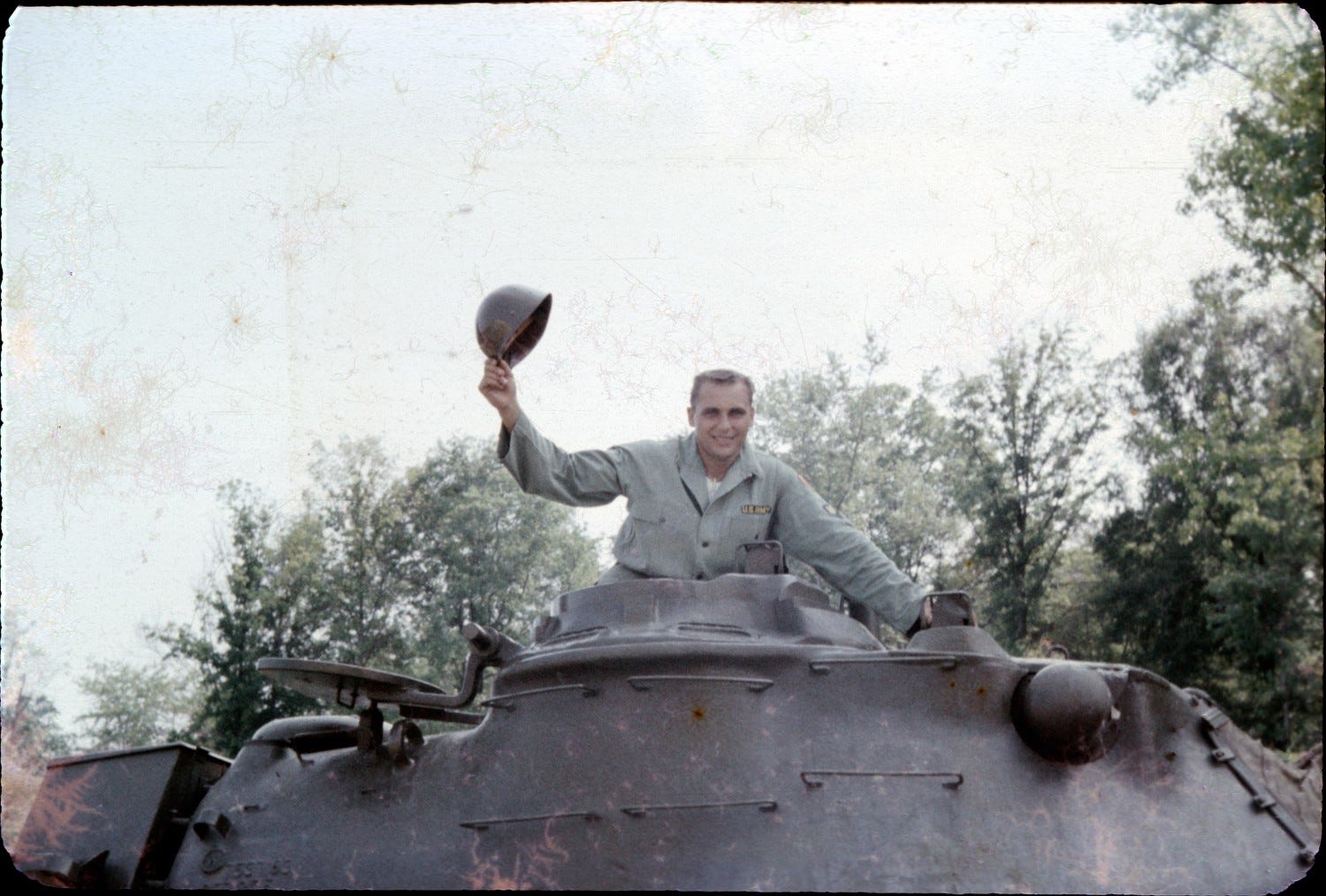
Sgt. Finlay Wood atop an M48 tank, a year prior to the Memphis crossing.
The tanks continued until they hit foxholes and machine gun nests at the entrance of the city’s proper limits. M48s then formed into their platoons, side by side, supported by federalist infantrymen arriving in trucks and armored carriers right behind them. In 12 minutes, they were at the main headquarters of the Socialist rebel garrison - their walled off camp, hundreds of tents across a field, a vehicle garage, and a large apartment tower. Albert had sent scouts the day prior ahead of the attack and handed out impromptu maps to the tank platoon leaders. Every lead tank knew what part of the gargantuan base was what, and they all had assigned roles. Platoon one rushed to the garage. The old brick building was up in arms, as socialist soldiers, rudely woken up from the fighting, were fleeing in all directions across the camp trying to get organized. Sgt. Finlay himself described seeing several rebel soldiers, some without pants, some without shirts, many unarmed, fleeing from his tanks as they rolled forward. A machine gun began to fire out, hitting some of their own people as they aimed for the tank’s optics and Finlay’s cupola. The M48 responded with a 90mm high-explosive shell to the side of the building, the bricks crumbling and creating a hole to the inside. Through the smoke, bloodied rebels could be seen, blinded by the shot. Some screamed, some fell on their knees, too shocked to even yell out into the morning sky. The havoc was far from over. The second tank in platoon one fired into a crowd of fleeing rebels, shredding dozens of soft bodies at once. Machine guns from each tank opened up, some rebels resorting to crawling to try and avoid the streams of fire. Finlay himself reported that his platoon was more than happy to crush any such “cowards” below their tracks. The M48s were in a killing field, and nothing could oppose them. Some tried. While the T-34 tanks had driven off before the battle began, the garage still had a pair of Cadillac Gage Commando armored cars, which had been modified with 20mm guns. One was activated during the course of the battle, charging in with an exhausted crew to face the tanks. 20mm rocked some of Platoon One’s M48s, stopping the advancing forces in their tracks while the armored car rolled around, continuing to shoot wildly into the Federalist mass. One M48 commander, Finlay wrote, was injured by a 20mm round that penetrated the top of his cupola spraying shrapnel inside the turret. He was lucky that none of his ammunition exploded. The Federalist infantrymen had no anti-tank weapons with them, and 20mm rounds maimed many as the armored car continued to fire off round after round. The car looped back around towards the garage, and Finlay’s platoon was ready. Tank number 3 in the platoon, to the right of Finlay, fired a shot right next to the armored car, causing the driver to crash into a tree. While the armored car was reversing, tank number 4 fired off a 90mm high-explosive shot. Smoke and flame began to emanate from the now silent vehicle.
Federalist forces continued the advance, infantrymen occupying the building and finishing off the last stragglers only 30 minutes into the fight. With the garage secured, the order came from Albert himself to move the battle line towards the high-rise that acted as the headquarters. All four tank platoons rushed forward, concentrating the assault while Federalist infantrymen crawled right behind the tanks, finishing off and securing any holdouts. Two platoons attacked from the right flank. Platoon 3 had been attacking the main camp, and it had been a horrific slaughter. Socialist rebels slept in individual tents, which were ripped apart by machine gun fire. Rudely awoken soldiers perished before they even made it out of bed, some crushed alive and squealing by treads as the tanks drove right through the center of their encampment. Cpl. Adam S., only 16 years old at the time, rode atop an M48 as it rolled through, using his M16 to eliminate any threats to the tank as the platoon maneuvered.
“It was awful. I held firm, rifle slung around my shoulders as the tank crashed through the camp’s makeshift fence. In a moment, I lifted up my rifle and fired a burst into the wild mass. I saw bodies running out of tents only to get struck by the tracers of machine guns, like swords cutting their way through the herd. The tank commanders fired into every tent they saw, riddling the people inside with bullets. I stopped firing after I used my first magazine, content with the killing. Those rebels were so unprepared, they couldn’t fathom what was happening to them. Some tried to hide in tents only to get crushed alive. I felt it under me as the tank shook, a yelp or gurgle and blood on the tracks before the tank driver continued to move. The tracks were red by the time we pushed through half their camp. My last kill was when I spotted two socialist rebels, they must have been a wife and husband or something like that. The man told something to the girl, a young redhead. Sometimes I wonder if she was young enough to be his daughter. The girl had run out of her tent clutching her helmet, putting it on, before the man handed her the rifle he had been holding and pointed for her to run. She began doing so, stumbling over other bodies and pieces of tents. The man started rushing towards us, holding a bundle of grenades. When my eyes crossed his hands, that is when I lifted up my rifle and fired. He dropped like a sack of potatoes. I later saw the same redhead girl near the HQ, after the battle was done for, being dragged out as a prisoner. It was a surreal experience through and through.” - Corporal Adam Sandler, discussing what happened during the battle to a talk show host in 2005.
The tanks advanced onto said headquarters at about 7:12 AM, one hour and 4 minutes into the battle. By this point, the T-34s had arrived back at the fort to attempt a counterattack. Albert, anticipating this, sent three Huey helicopters to hunt them down with mounted rockets. Before the tanks were even in range of the Federalist attack force, the Hueys’ made four separate passes over them, dodging fire from top-mounted heavy machine guns to launch 28 total rockets, killing at least 23 of the 40 soldiers in the convoy, destroying two T-34s completely, and detonating the mortar ammunition. The devastated convoy routed and fled, abandoning their tanks a few blocks away to avoid attention.
The M48s fired repeatedly into the high-rise which was crawling with rifle and machine gun fire from every window. Infantrymen suffered high casualties during the assault on the HQ due to the high angle of fire and the lack of appropriate cover. Round after round slammed into the building, tearing away the paint and concrete, leaving shards of blown out class and concrete rubble around as the complex eroded dramatically. The highest casualties were suffered when the high-rises 18th floor gained the best weapon the rebel force had. A BGM-71 TOW anti-tank missile had been captured from a federal armory months prior, and after 20 minutes had been brought up and set up under heavy fire. The inexperienced TOW operators were not at all efficient with the setup, and their first shot came out at 7:49 AM. A moving M113 took a hit straight to the front of their right tracks, disabling the vehicle and forcing everyone inside to evacuate, wounded and shocked. Tragically, the blast and shrapnel killed 4 Federalist infantrymen taking cover by the vehicle. The explosion signaled to the tanks that there was now a greater threat on site. The tanks had been firing shots into the center of the building with great effect, silencing machine guns and allowing Federalist soldiers to come ever closer. The entire structure was riddled with bullets and entire wings were now aflame, creating vicious black smoke around the western sections. Finlay himself tried to spot the TOW missile launcher, ordering nearby infantrymen to stop firing suppressive shots and instead aim for accurate targets in order to stop the confusion and locate the threat. Firefights continued however, and Federalist soldiers refused to exit the warped halls and rooms within the high-rise. Infantrymen tried to get inside, hoping to clear each room and make their way to the missile launcher. At 7:51, the second TOW missile shot rang out. It would haunt all those present on the Federalist side.
Tank number 3 in the second platoon was hit almost directly on the turret rear by a 3.9kg warhead, detonating all ammunition within the tank 20 seconds after impact, already having killed the entire turret crew. The tank was the first complete loss due to enemy action, the entire crew dying in the process. Quick to respond, the M48s attempted to fire at the direction the missile had come from but their gun barrels ended up being too low in elevation. They fired at the floors below, hoping to collapse or force away the ATGM operators. Machine gun rounds spewed and riflemen made their way inside the building trying a desperate move to try and make it up. It was an impossible task, there were still far too many rebels and the stairwell was filled with smoke from raging fires, entire sections of steps gone from tank shells hitting them. It was too dangerous a chasm for anyone to win inside. Reluctantly the infantrymen fled the five floors they were able to push through. The third and final ATGM shot rang out, hitting an M113 that was transporting an artillery piece towards the building. The vehicle was hit directly, and all four men inside died from the blast, alongside 3 others near the vehicle killed by shrapnel. By this point, one of Finlay’s tanks had reversed far enough that they could aim their gun up high, and at 8:09 AM, killed the ATGM crew with a clean shot of his 90mm.
Another tank was destroyed completely a few minutes after, from an enemy RPG-2, certainly smuggled in from a Kenestik ally. A garrison unit from inside Memphis had moved in, in lieu of the power being shut off leaving communications in darkness. It was likely that some fleeing soldiers had made it across the city to warn them of what was ongoing. 50 rebel militants however, even armed with Kenestik rifles and anti-tank weapons, did not make too much of a difference. After suffering 50% casualties, they fled the fort zone, retreating in through and out of the city to reorganize with the rest of the survivors. The remainder stuck inside the high-rise building fled, some throwing themselves down due to the stairwell being filled with smoke. Federalist soldiers, organized and pouring in, opted to take them prisoner and not enact revenge due to Albert’s belief that it would enhance their victory to parade around these “traitors” later.
Albert himself had a habit of sticking beside his men during active combat, putting himself in danger more than once to command different company officers in order to ensure discipline. He had once stated to a war correspondent that Vietnam taught him to do this. “Nothing goes right once the battle begins, and that’s alright, as long as you’re watching and the men are watching you.”
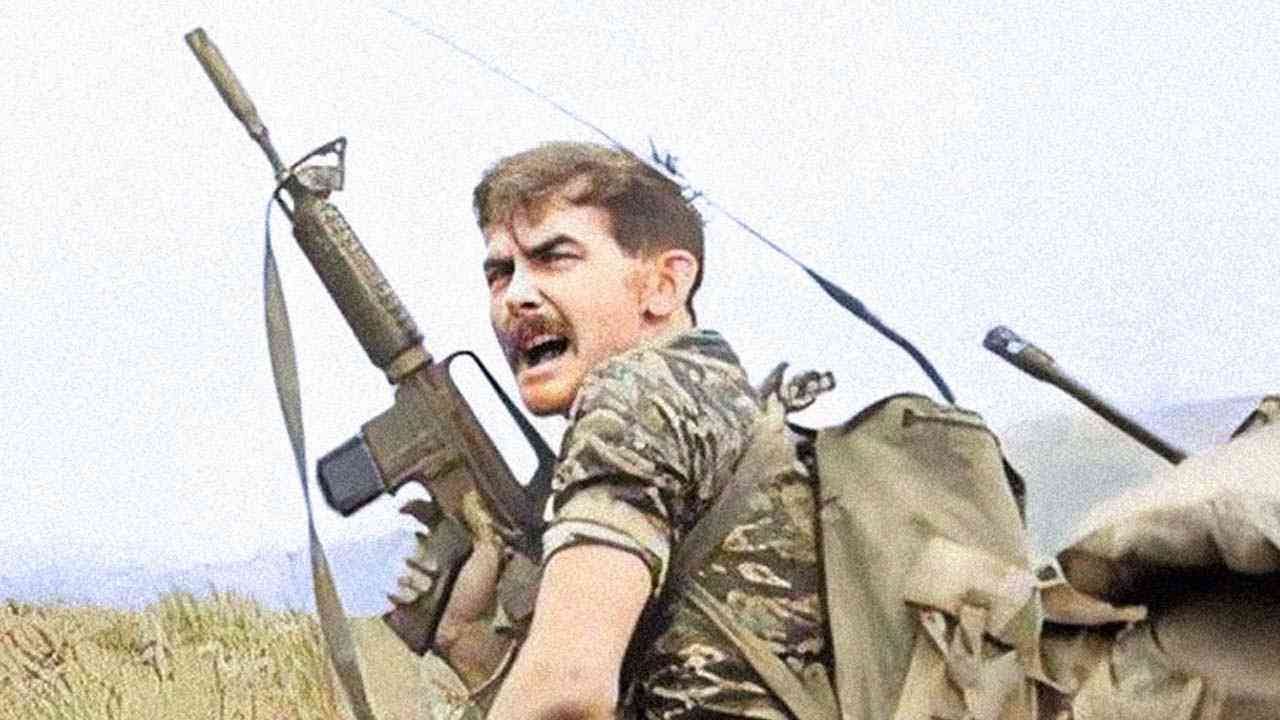
Albert “The Mantis” Theodore wearing his signature tiger stripe uniform on the Island, during the Memphis Crossing. Photographer PFC L. Gardner from 8th Company, 2nd Brigade.
While Federalist troops continued on to round up the newly gained prisoners-of-war, the tanks went ahead to secure the intersection joining Route 69 and Route 40. This is where they ran into a platoon of well-armed Socialist Rifle Corps members, and a dozen or so volunteers that had been gathered up in the morning to try and defend the critical highway junction. While some tankers wanted to ask the men to surrender (to avoid having to fight them and end up damaging the highway), Albert spoke over the radio that they were to secure the junction without hesitation. The tanks obeyed and moved in against the 43 defenders, who had parked a bus and a few cars on the highway ramp to try and stall the tanks. The team of SRC soldiers had a M9A1 Super Bazooka with them, and started firing rockets haphazardly as the tanks approached. One tank was hit, but the Patton’s armor was able to resist the outdated HEAT warhead. The tanks fired back in a salvo, ripping through the vehicles and killing many of their enemy in one go. The Socialist soldiers continued firing, stray bullets hitting the cars of citizens and the windows of nearby houses. The bus caught on fire in the firefight, covering the entire highway area with thick black smoke. The Patton’s struggled to make out targets as they machine gunned any shape they could discern coming out. The Socialists held their ground, but eventually the tanks went up the east side of the highway ramp and got a clean shot on the remainder, causing all but two socialist soldiers to die or become grievously wounded. The duo that were not maimed started running off, and the M48s decided it was not worth it to pursue. The tanks had suffered no casualties but had been peppered with small-arms fire, and so had been the nearby city center. At least 3 civilians suffered serious injuries from this engagement, and one later died at hospital. The tanks held the highway junction, sitting in formation, now overlooking the west and east coast on their sides.
Below, in the underpass of the highway, Federalist soldiers would discover why the SRC soldiers were there in the first place. An entire section had been created into a military outpost, cordoned off with chicken-wire fencing and housed a cache of weapons, sleeping quarters, sandbags and an area for detained persons to be jailed inside. This was set up to control the center of the city and prevent civilians from freely using the highway, a testament to the tyranny of Socialist occupation. It was later found out that this station was originally constructed differently, but a lone member of the Tennessee Ku Klux Klan had armed himself and went on a raid at night, killing the socialist guardsmen and grabbing the cached weapons, before escaping with dozens of other civilian families who wanted to leave Memphis and escape to the West Coast. After that incident, security was tightened, and a platoon of well-armed fighters was kept permanently at the underpass.
Part Five - Path Secured
With the defeat of the Socialist garrison at Memphis, Albert, now going by his codename - “The Mantis” (which he had earned in Vietnam but fully codified because of this violently efficient maneuver) - began the second phase of Federalist Operations. The reorganized United States Navy, led by Admiral Eric P. Musgrave, nicknamed “Muskrat”, had seized and now controlled New Orleans. The hard fought battle between U.S Marines and the SRC in the city had opened up the Mississippi River, and Mantis taking Memphis had cleared a secure port for the large warships to sail up towards. From this, Admiral Muskrat began his own operation - Operation River Dam, focusing on eliminating all semblances of resistance on the Mississippi River. This would include an ethnic-cleansing as it was deemed colored persons made up the majority of the Socialist supporters in this region, and the only way to end their violent uprising was to kill every last man, woman, and child of the African race. Muskrat began his operation from Louisiana, while Mantis himself focused on setting up a supply line and clearing out all Socialist insurgents around Memphis and the I-40 highway.
By the time Muskrat reached Memphis during his massive scale bombardment campaign of the riverside, it was late 1981, and Albert the Mantis was now promoted by the President to become a 5-Star General. Supply lines had been established and fresh conscripts, alongside newer vehicles, reached Memphis. Mantis now directly commanded three divisions, one of which had made their way to assist Confederate defenders in Eastern Tennessee. Another had secured St. Louis, and was on the path to surround and start the Siege of Chicago. The division in Memphis was re-equipped with M60A3 Main Battle Tanks, offering much better protection and firepower to the soldiers present. The infantrymen switched out their old Vietnam era OG-107 uniforms for the ERDL pattern fatigues, issued specifically for Mantis’ unit to gain an advantage over the Socialist rifles (who had no camouflage whatsoever outside of civilian patterns). The unit received a shipment of arms, replacing all remaining M14s with M16A1s and supplied them with ample amounts of heavy machine guns, grenade-launchers, anti-tank weapons, and they got vehicles to carry them with. Most importantly for Mantis himself was that they finally received a large wing of fixed wing close-air support aircraft, including the entirety of the 49th Fighter-Wing, a fleet of F-15A Eagles, decked out with new munitions ready to strike targets for the Mantis. After meeting Muskrat personally in Memphis, Mantis began the march forward, with his modernized force and aircraft support, in total numbering 4 wings with the previously mentioned F-15s, F-4 Phantoms, F-111 Aardvarks, and OV-10 Broncos. The brigade moved through Tennessee, joined by the counter-attacking members of the Ku Klux Klan and the other Federalist division supporting them. The combined forces now numbered 23,000 Americans against only 14,000 SRC members, now retreating down to Alabama unable to cope with the firepower thrown atop them.
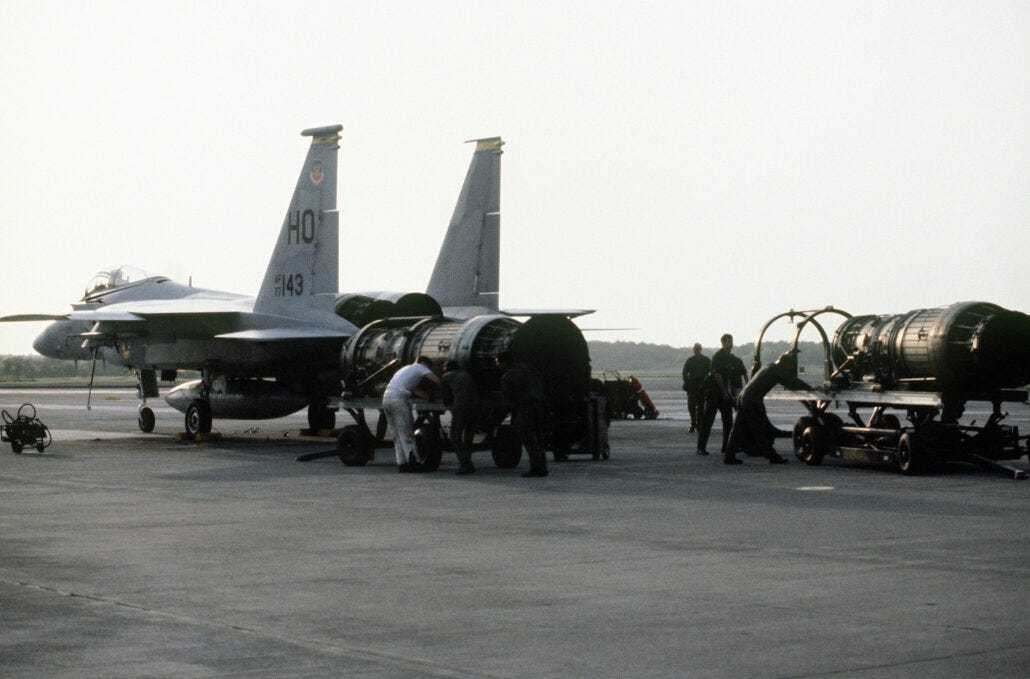
F-15 of the 49th Wing, 8th Tactical Squadron, undergoing an engine swap.
A young boy at the time, James Wilkinroy, had been forced out of his Alabama home earlier in the war, as his family land was declared communal and as a reparation to formerly enslaved Africans who now formed up a section of the Socialist States. Seeking to avoid being massacred, his father decided to burn down their estate rather than let it be taken and escaped in the night to Tennessee. There, his father, mother and James all joined together as volunteers for the Klan’s Armed Wing, forming the defense line in Tennessee. From his 10th Birthday to his 12th, James had only known fear and desperation as they spent two years marching with the Klan in retreat as their forces were overwhelmed by the Socialist Rifle Corps. The family was often split up, with James himself working with other boys to dig defenses, carry munitions, and manning anti-aircraft machine guns to guard the camp. His father fought as a reconnaissance infantryman, and his mother lived amongst the other women of the camp doing their duty to treat the injured and cook food.
“It was late in Autumn. I was at our camp, somewhere not far from what I knew as Cotton town. Me and three other boys were guarding the hills, operating the searchlight. We could see the SRC formation on the other ridge, with their Sherman tank copies and gun-trucks. They were going to assault us in the morning. I hadn’t seen my dad in days by that point, and only got one moment to talk to my mom. I think we all knew, the three of us there, that this was probably going to be our last night. We had survived so much only to run out of time and space to fall back to. The miserable camp sat behind us, full of ragged and wounded men trying to sleep after days of fighting. It all changed in a moment. I heard the sky break, as if a thunderstorm (not uncommon) was going to start up. I instinctively reached for my coat, and stepped away from the bright searchlight. I saw it. A bright, orange stream, like two blowtorches, forming lights in the night sky. There were four pairs of them, but you couldn’t make out anything else. They passed by us, a great and powerful wind screaming across the valley. Then, we heard the bangs. I ran with my binoculars, surrounded by my shocked compatriots. The enemy tanks and camps across the ridge were now covered in a big cloud of dark gray smoke, impenetrable to the human eye. They were all gone, right there and then. The Air Force was back, and they had just wiped out the men that had terrorized us for years in a mere twenty-seconds.” - James Wilkinroy, speaking to a documentary crew in 1998 about his experience.
With the combined forces of two Federalist divisions and every person the Ku Klux could muster, Mantis pushed back the organized socialist rebels all the way into Montgomery, liberating the city on Christmas Eve of 1981. In three months, the Mantis Brood and combined Klan forces had liberated the major cities of Alabama, absolutely crushing the resistance in their way. The entire offensive plan of the Socialist States, including the “Socialist Militia of Tennessee” had been destroyed by American steel. Socialist forces in Georgia, South Carolina, and Florida rapidly marched to Alabama trying to counter this massive force that was now about to split their country in two, a second time.
The reinforcements came flooding in by 1982. The U.S military contingents in Vietnam had returned at last, and Muskrat was quick to send in more and more Marines. A reconnaissance landing in New England and Long Island had turned into a full scale recapturing offensive, leaving the Socialist Capital of New York City under direct threat. The Socialist Rifle Corp, a once proud and well-formed military force, fell to waves of conscripts from the Socialist Militias of various states, scraping the barrel for men and women, who slowly began to take up a major percentage of the fighting force. Worse for the socialists was the presence of American strategic bombers, the B-52s now flying daily missions to take out Socialist supply lines. The surrounding of Chicago and Detroit meant almost every new piece of equipment, from tanks to rifles was now cut off and socialist units had to make do with what they had. The Federalist Armed Forces were now comfortable, with stacked numbers of veteran soldiers and more ammunition than they could need. The Socialist cities declared total mobilization and all pretenses of being a functioning state about to gain independence stopped. All efforts were on stopping the rapid Federalist forces and their vengeful Confederate-Klan allies. That was easier said than done. Theodore the Mantis himself demonstrated this at a strategic battle. His unit pushed their way down the highway, letting their Klan allies clear the countryside out while they headed for the strategic target of Mobile. In two weeks of fighting, the last formation of the SRC in Alabama was completely routed, with around 3,400 killed or captured. A massive blow was also dealt to the remainder of their air forces - Rebel captured F-4 Phantoms flown out of Mobile engaged Mantis’ cover units of F-15As, giving the F-15s their first proper air-to-air kill. With the defeat at Mobile, the SRC’s Marshal Tom Kahn called back all forces from Alabama and disbanded the Socialist Militia of Alabama, incorporating everyone left behind into the SRC’s ranks.
After his rapid victory in Mobile, Mantis once again departed from his forces of operation. It was time to focus up north, seeing that the SRC was left with some 57,000~ fighting persons only in the region, against Muskrat’s 2nd MARDIV (20,000 veteran soldiers) in New Orleans, the Klan’s own 9,000 fighting volunteers, and 43,000 Federalist soldiers. Instead of pushing deeper into the Swamp, Mantis took his personal brigade of now 2,500 to relieve Marine landings of 2,000 men in the Tallahassee area. In late summer, bogged down by mud, Mantis finally smashed into the rear of the Socialist Rifle Corps’ line attempting the counteroffensive, and over the course of a month completely annihilated the entire force, hunting every last man and woman to the swamps. Wasting no time, he joined in the federalist offensive in Atlanta by pushing up Route 75, tearing apart the meager resistance in his way. By the time he reached Atlanta, most of the city had already been captured by a Klan-Federalist joint division, and Mantis did not stick around long as usual. In 3 weeks, he had blitzed his way up to Maryland, going through Federalist secured highways, rearming and resupplying along the way. Taking quick action, he launched a major offensive with his brigade into Eastern PA, focusing on taking back Scranton, PA, and the surrounding regions. Under orders by the President himself, Mantis went around the rogue state of the CPNAS, instead moving through clean farmland to assault the rebel flanks. The SRC stood no chance, and despite having larger numbers, was quickly pummeled. Mantis also had several B-52 bombers on standby to disrupt any reorganization attempt. In the battle for Scranton, his 5,000 man strong Brigade and Klan volunteers absolutely annihilated a 12,000 man SRC and Socialist volunteer military garrison, capturing more men than they even had in the first place, with only 800 casualties on his side. Most of the prisoners were liquidated in the fields of Bucks County, only 1,700 individuals being spared out of the total 6,400 prisoners of war. They were then incorporated into a penal battalion and marched ahead to gauge SRC defenses. Considered traitors for surrendering under the harsh battle laws of the SRC, the men and women had no choice but to suffer harsh casualties fighting their former comrades. Avoiding Philadelphia due to his lack of long-term siege supplies, Mantis went straight for northern New Jersey, sending a combat team to link up with local Federalist units and tear apart the tri-state bond that connected Upstate NY and NYC/NJ/PA. In a major assault on the remaining Socialist fortifications, Mantis’ infantry managed to achieve their goal in only 5 days of fighting, sending the Socialists scattering. The SRC now dug in outside of Newark, Harlem, and Brooklyn, surrounded on three sides by Federalist controlled space. Mantis’ personal tankers pushed into Newark, receiving reinforcements from Allentown. In the battle, 25,000 well-dug in SRC recruits faced off against a meager Federalist Force of approximately 3,000 of Theo’s Brood, 400 Klan militants, and 1,240 Pennsylvanian Federalist volunteers. It was expected that Theo would be absolutely slaughtered in the assault, had it not been for the final trick up his sleeve.
Admiral Muskrat had sent his Iowa-Class Battleship, the USS New Jersey, fully armed with an escort fleet to bombard Newark. As soon as Theo’s forces began the skirmish, the fleet began to target critical defensive zones with precision missiles, alongside mass shelling of military targets using their big guns. At the same time, the USAF moved in, risking enemy fire to drop bombs from B-52s, F-111s, F-4 Phantoms, and provide close-air-support with newly produced A-10A Warthogs, OV-10 Broncos, and AH-64 Apache Helicopters. The Socialist Riflemen, mostly an infantry unit with lackluster anti-air defenses, no anti-ship defenses, and a fleet of old M48A1/M48A3 Patton Tanks, were absolutely slaughtered by the joint land, navy, and air force attack. 12,000 died from shelling, bombardment, gassing, airstrikes, and Apaches alone destroyed 39 enemy armored fighting vehicles with their missiles and rocket pods. The Newark Garrison surrendered in 3 days of fighting, having been expected to hold out for three months. 7,300 SRC members that could not flee surrendered themselves to Mantis’ force. Mantis liquidated 2,400 of them on the spot, dumping their bodies in the harbor. The survivors were taken back to friendly lines to be processed as prisoners of war. Having taken 1,200 casualties during his campaign, including 900 deaths, Mantis decided to stop at Newark, lest he lose his entire now 4,000+ strong combat team. Most of his Vietnam-Era soldiers had now been promoted to senior officer ranks and were not present during active combat anyways, and he was not confident in the newer recruits that had replaced them. To capture a big prize like New York City, would take far more manpower and veterans from the Southern Front.
Part Six - Remittance to Circumstances
The war sped up relatively quickly after the winter of 1982. The Federalist Army and their USMC support numbered into a massive fighting force of 192,250 soldiers. Their armored support was consolidated, numbering 11,000 M60A1 and A3 main battle tanks, many upgraded with thermal sights. Alongside them were a good number of 8,600 M48s providing fire support, and now - a brand new tank, the M1 Abrams, had also been introduced into combat. Mantis’ division would not get M1 tanks immediately, but he was negotiating for them even before their official entry into Army service, early summer of 1983.
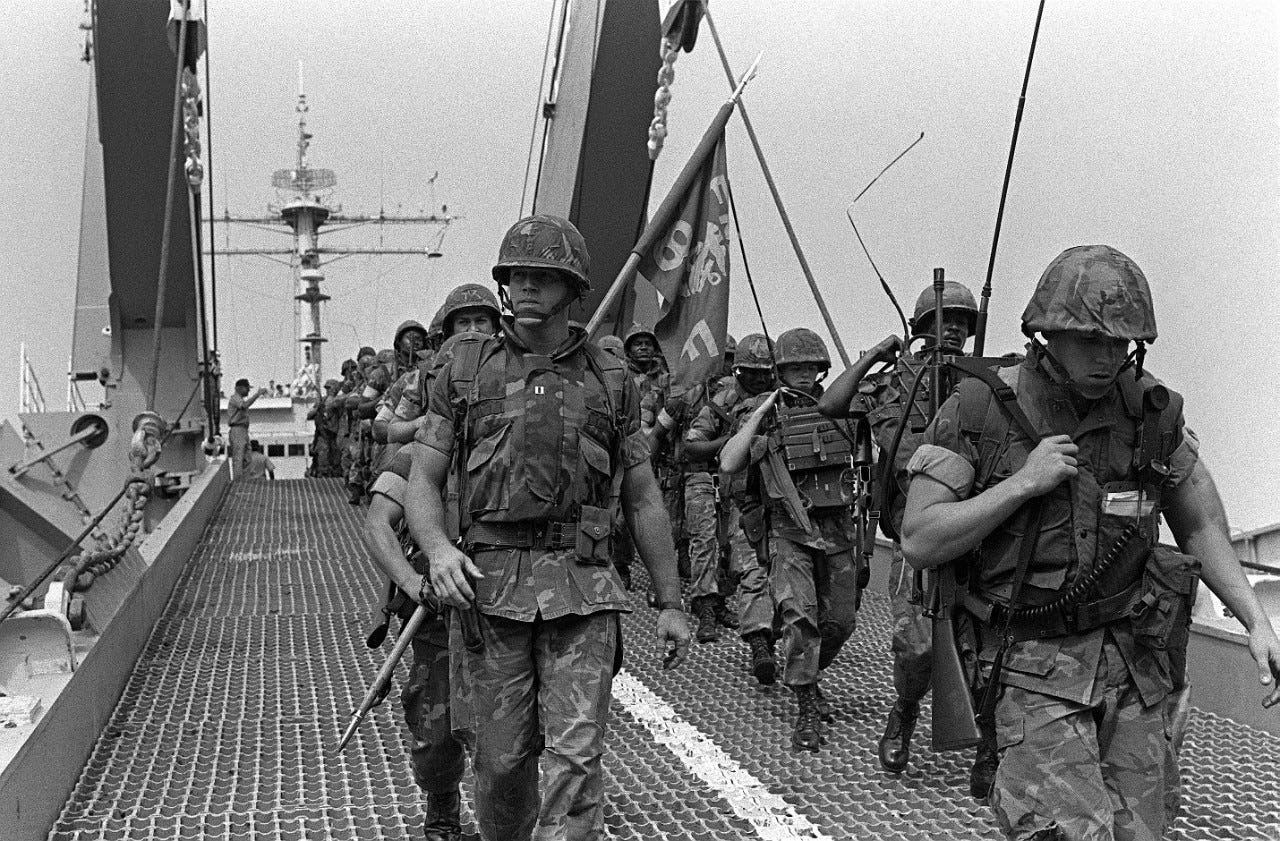
U.S.M.C infantry exiting a landing craft vehicle, coming ashore ready to continue the fight against the SRC/SVB.
In stark contrast, the once Socialist forces had been decimated.
A chart from the time published for military intelligence breaks down the troop count in simple terms; The combat strength of the Socialist Rifle Corps (the elite branch of the main rebel bloc), the strength of Socialist Volunteer Brigades, and the strength of other various factions that had allied themselves with the Socialist States.
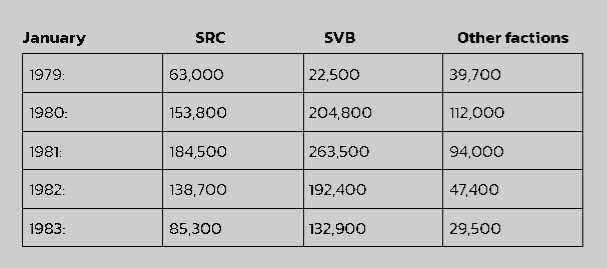
Most of those remaining SRC and SVB soldiers were concentrated in the New Jersey and New York pockets, under the sorrow of constant decapitation strikes led by the U.S.A.F against their senior command. Worst of all, their 4,000 fleet of tanks (M4A3E8, M26A1, M46, M47, M48, M60, T-34-85) had been reduced to an almost zero - only 153 tanks were left by 1983, and continually preyed upon by Federalist Army AH-64 Apaches and A-10As. Most tanks were abandoned because it was not worth the risk for Socialist volunteers to man them. Many of the M4 Sherman tanks produced in the (now retaken) cities of Detroit and Chicago became nothing more than prize trophies, far from the triumphant parades the Socialists had held with them the year prior. With New York surrounded, the Midwest and most of the South slowly falling, it seemed that the situation was hopeless. Still, Socialist fanatics gave it their all. Soon, their parliament instituted an anti-desertion law, followed by a law against defeatists. Several men and women were executed in Times Square for defeatism in the harsh December of 1982, surrounded by snow, Federalist jets tearing at the city above. Socialist morale was at an all-time low, and something was about to make it worse.
Much to the chagrin of military commanders like Mantis, and his revengeful Klan allies, the President himself called upon a new, public decree. This controversial plan declared that all Socialist commanders and units who turned themselves in without a further struggle would be given amnesty and allowed to return to their homes. No trials of any enlisted man were to take place, said the POTUS communication center. Albert was furious at the news of this - He ended up knocking the teeth out of the poor government employee unfortunate enough to be the one delivering it to him. For this entire time, the plan was to light a total and punitive fire. Albert himself routinely executed or let his Klan allies execute any socialist prisoner-of-war they found unfit of continuing existence. The standard across Federalist troops was to kill all the traitors, except the senior officers that most of the leadership expected to hang in a victorious fashion, perhaps beside the Washington monument or somewhere similarly patriotic. The President’s decision to declare pardons caught everyone off guard. The few running Socialist newspapers and communication networks instantaneously declared it a trap, warning of grim consequences to those that chose cowardice - either from the Federalist enemy or the Socialists themselves. This rash action by the President actually got several senior lieutenants of the Alabama Socialist Volunteer Brigades lynched - Angry Klansmen would not allow their justice to slip by a pardon, and burned down a Federalist prison, hanging 27 Socialist officers (highest ranking of them being a colonel) alongside 439 Socialist prisoners of war, including detained civilians with their wives, children also being killed by various brutal methods. Most of the guards did not interfere with the Klan takeover, seeking to instead put their weapons down and obey orders from the hostile southerners, either to avoid being killed by the crowd, or to avoid having a death on their hands - just to protect people they were fighting and hated in the first place. This event only fed into socialist propaganda, causing pockets of resistance in the south to continue fighting rather than surrender. The plan eventually worked though, beginning in the month of February, when the Bostonian pocket of Socialist Rifle Corpsmen (4,000 in number) and 5,000 of their volunteer comrades surrendered Massachusetts to the encroaching Federalist and Marine Corp attack force. Their surrender was followed by the SRC division spread out in the Carolinas, and many of their allies, 24,000 total surrendering, including SRC General Evan Thomas, who handed in the entire command of the “Carolinas” united socialist army group, a formation that was a shadow of their former selves after most of their men had run off to defend Georgia in failure. Evan was the highest ranking officer so far in the Socialist Bloc to accept a surrender. Finally, after the battle of Buffalo NY, a brutal but decisive victory for the Federalist Army, the entire New York command of the Socialist Rifles, Volunteers, and their allied militias surrendered, having been running out of food, ammunition, and hampered by their large number of wounded. They simply could not fight on after Buffalo, their main headquarters, was ravaged and retaken by a large Federalist veteran force. This began to become a present reality for the entirety of the SRC and their bloc, with Socialist units becoming full of infirm, wounded fighters and no cities to take them back to, or supplies to provide for them. Food stores had collapsed in August 1982, and now Socialist units had the choice to either starve under sieges or surrender themselves to the Federalist onslaught. From the woods of Upstate New York emerged thousands of young soldiers with their hands raised high, under the judgment of angry and violent war veterans. At best, SRC members could expect a minimum beating and humiliation. At worst, wounded Socialists were left to die while the survivors were massacred or tortured half to death. Albert himself sent out an official memo on March 5, 1983, ordering the halt of “lootings, tortures, assaults both physical, sexual, mental, or otherwise upon disarmed rebellious forces”. The only reason the order was obeyed by anyone at all was due to the high respect the Mantis had gained amongst his men. This respect would be doubled when, after the wrap up of other fronts by July of 1983, the Federalists began to focus their attention on the last Socialist holdout region, having defeated the death throes of enemy resistance in the south. New Jersey - Delaware - N.Y.C.
Part Seven - The Final Battle
Over the skies of Newark, the shape of New York City in the distance gleamed in the late summer sun. The massive skyscrapers, slightly obscured from the smoke rising around them, were still vigilant, even with sides covered by ragged red banners. The United States and her shadow began creeping up to this city, filled with the filth that infested it. Uncle Sam and Lady Liberty were soon re-united. Not now though, at least not for the men on the ground under Theodore’s command. He had ordered a quick assault, combining elements of differing allied factions to take their biggest cities back under the stars and stripes.
A man, an ant compared to the buildings around him, stepped down. His sneakers squealed on the concrete, and his steps were followed by another. Private First Class Bradigan, clad in the outdated olive drab worn by Federalist-allied Pennsylvanian Guardsmen, led his friend towards a fiery visage. A Newark Police Department truck danced orange and yellow with crackles and smoked finely in the morning coastal breeze. Inside, was a lone shape in the drivers’ seat, now turned blacker than anthracite.
“Y’know….” The soldier said to his comrade, the two crossing the street and walking up to the front of the precinct that now similarly burned.
“No, I don’t” Corporal Wilson, the man he was with, responded with admonishment. Wilson was busy looking at the distance, a distant air raid ongoing during their conversation.
“That bastard there, burning in that truck.” The young private stated, pointing at the corpse, squatting down beside a railing built into the concrete. He pulled his rifle by his stomach and started searching in his side pockets as he spoke with his free hand.
“What about him?”
“When I was thirteen, he busted me. For smoking a pack of Parliaments.”
Wilson laughed. “Do you think they’re still in there with him, burning up and all? ”
“Nah. He used them all up in half-an-hour. I saw it, while I was waiting at the station. Guess who’s the smoker now you fucking pig, ay?”
While the two frivolously discussed the death of the collaborationist police officer that was now entombed in the vehicle before them, steel tracks rolled by. An M60A3 main battle tank, clad in the symbols of the Confederacy, flying a Tennessee Battle Flag on top. Men rode atop it, stern and focused, some bearded heavily. Veterans had arrived for the cleanup, men who had seen their lives destroyed in the south. Now they existed for warfare, and the Mantis had taken them to their purpose. As the tanks passed through, Bradigan pulled out a fine, thin cigar from his pocket. He pulled another one right after, handing it to Wilson. Behind the tanks were M35 trucks, one with the California Republic flag painted on the hood. Bradigan lit his end, and then reached over to light Wilson’s cigar. The two men, both natives of this town, now stood by the destructive forces ahead.
Albert had calculated the offensive in depth, but knew better than to micromanage the situation. He had four majors leading different elements of his brigades as they pushed up into the thick urban jungle of the tri-state. The one he chose for the assault on New York’s center - including his own hometown of Staten Island, was Major Leon Boucher. Boucher was born in New Orleans, but had lived in the army, entering the West Point Academy in 1972, just in time to serve during the Siege of Hanoi. Boucher had led his company to victory in the dense urban confines of Hanoi, but paid a heavy price. His right arm’s ulna bone and a 7.62x39 round had become married, and it essentially put his main hand out of action. This did not stop Boucher, who refused to accept an honorable discharge. He continued working at an administrative level, still burning with a fighting spirit that had come in useful during the southern campaign. Theo had moved him from the 4th Federalist division into his own brood, bringing him under the fold of the Mantis family. His test was now to organize the main assault, which was backed up by significant amounts of aircraft. Indeed, there were so many aircraft involved in the operation that the I-95 ended up being used several times as a runaway. Boucher’s forces consisted of an armored force, an infantry force, and a marine force. 95 M60A3s/A1s being carried forward as fire support, a mixture of newly retrained southern militiamen. The infantry came from a Californian volunteer battalion, raised by the Federalists in 1982. The Marine force was a sparingly used group of amphibious armored vehicles deployed and protected by navy ships, for the purpose of securing Staten Island harbors, all the soldiers originating from the 2nd Marine Division (under Muskrat’s command). The Navy itself would once again provide fire support, though the President communicated to Mantis and Muskrat specifically to not target buildings of economic or historical significance, such as the Empire State Building, the Flatiron tower, the former World Trade Center (Renamed World Socialist Congress by the enemy). All the churches which had been sacked by the Socialists were also blacklisted from bombardment, as the President hoped to rebuild them as a sign of victory.
While his naval equivalent, Admiral Eric Muskrat, was more than happy to accept these terms, Albert was not. The Mantis required immense firepower, and he knew it would take far longer to fight through the cities, 8-day battle plan, possibly taking weeks to capture a borough. America needed to win and repair itself, and it needed to complete that mission quickly. The President however, overruled the Mantis, and threatened the war hero who had led his army to victory. In response, the Mantis brought his Klan allies along for the ride as the troops began to pour towards northern Manhattan, promising them free reign to do whatever they wanted to the inhabitants after their victory.
Major Boucher led the first offensive on August 4th, smashing into the SRC’s Newark line. Tank-on-Tank combat, a rarity, occurred in the cluttered streets. Boucher sent hellish waves of infantry attacks, made up of massed Federalist veterans bringing brutal, close-up war to match the SRC’s fanatic defense. The immeasurable firepower advantage led to the Socialist lines being completely destroyed by next morning, the remnants of the SRC caught off guard and fleeing through the Goethals bridge, towards the more open space of Staten Island. Albert gave a last call to Major Boucher at dawn, telling him to “Take Mid-Island by sundown, lest we face the consequences”. Boucher responded that he would fulfill his mission no matter the cost. The SRC attended to blow up the bridge, but their lack of explosive technicians and Federalist airstrikes prevented them from setting up any clear plan to detonate Goethals. Boucher crossed with his forces during the airstrikes, telling the air force to keep shooting across Bridge Creek until they saw American flags in their sights. Three infantry battalions and 43 Patton tanks pushed towards Mid-Island, facing dug in defenders. Nevertheless, Leon coordinated his men, securing the junction, then Westerleigh, keeping the advance moving forward. By 1600 hours, the decision was made by the Air Force to completely annihilate Todt Hill with napalm dropped by three requisitioned B-52 bombers. Leon, riding an M60A3 Patton, ordered his men to charge up and run into the suburbs immediately after he saw the flames in the air. Through the fireball, Federalist soldiers, reportedly having little care for their own lives, crashed with bayonets fixed into the embers of the SRC, wiping out the last major force resisting on the Island. The infantry wave spread through like a fire of their own, clearing suburb after suburb of all remaining socialists, Leon riding alongside them, carrying a rifle himself. The rifle was not left dormant, and Leon tallied at least four more kills to his name at Emerson, where an attempted SRC counterattack failed to contain their enemy. Federalist forces from other “Mantis Brood” units rolled up soon after, facing a demoralized and weak group of Socialist volunteers who quickly threw up their arms after either witnessing or running from the carnage further north. As promised, Mid Island was secured by nightfall, and the Staten Island Expressway trembled under the weight of a Federalist armored vehicle fleet. The price was hard to pay, however. In one of the highest casualty days of the civil war, 900+ Federalist soldiers had lost their lives, a dozen or so tanks were gone, and a further two-thousand was wounded, including Major Leon Boucher himself, who received shrapnel to his left eye leaving him partially blinded, with facial scarring. Boucher would don a black eyepatch the rest of the campaign, once again refusing to accept circumstances and willing to continue the fight against socialism.
“I was just, in absolute and complete disgust as my soldiers collected the bodies of the communists…,the wretched scum. The sky was blackened, the sun…it was invisible to us. It felt like God himself had completely forgotten this place, my heart consumed by hate. Alas, I knew we were victorious, even as the nurse was stitching up my face, even as I saw the trucks carrying away our own black bags…” - Major Leon Boucher, December 15, 1983, talking to a journalist.
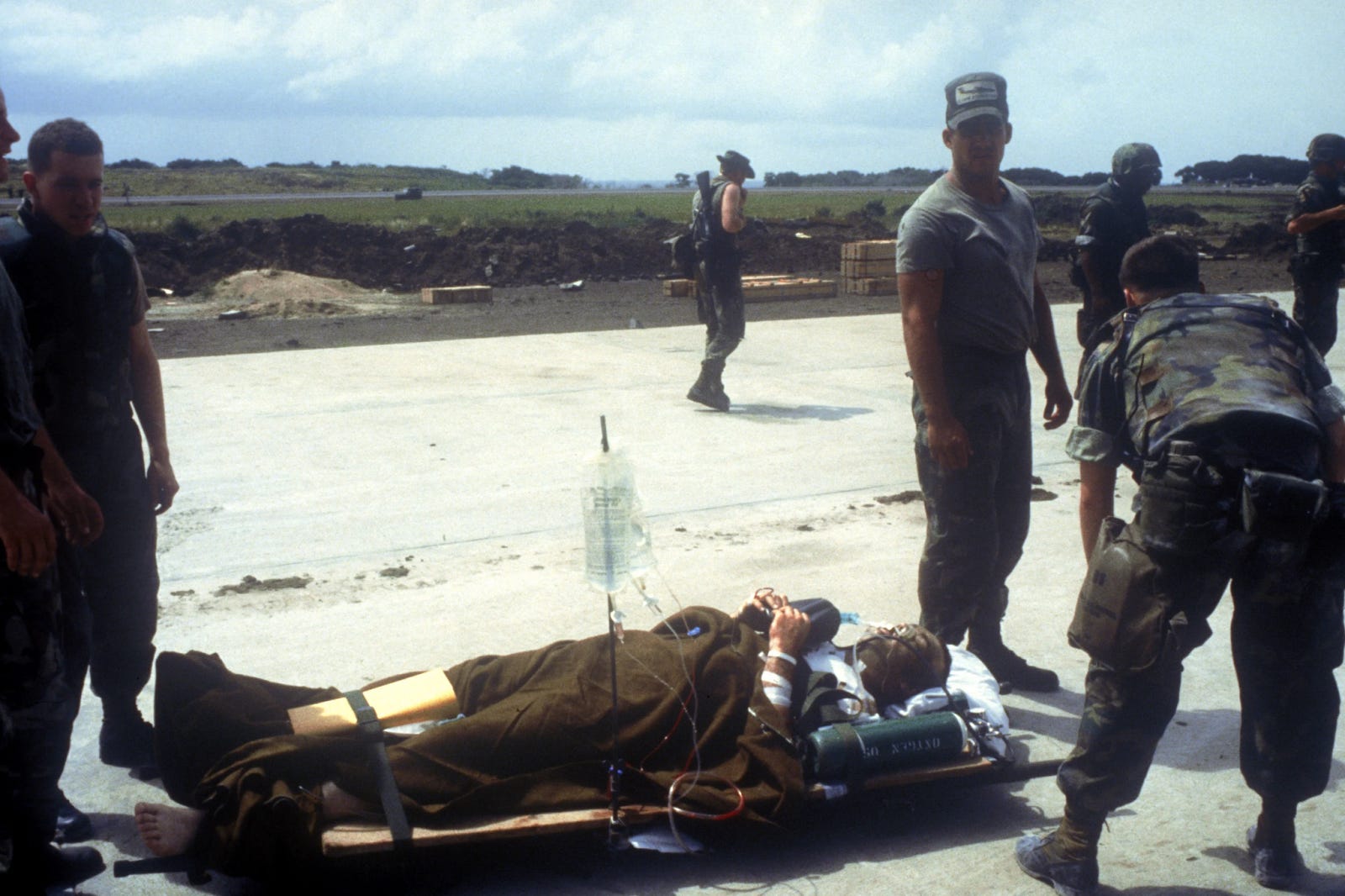
U.S military personnel waiting for medical evacuation helicopters on S.I.
Due to the incremental pressure coming from the north, alongside the loss of Staten Island, the Socialist government inside Manhattan, divided between fanatics, ended up shooting each other several times. African Supremacist gangs that had sided with the Socialist bloc, headquartering themselves in NYC, now faced extinction. They turned on their allies, some even trying to escape the city, only to be intercepted by Muskrat’s gunboats. The collapsing defensive line meant that even before Federalist troops reached the city, the war-weary citizens and their socialist officers had lost the will to fight long ago. The tankers speeding in from the north faced more of a welcome than a resistance group. The few that tried were rooted out in quick firefights.
By the time the Bronx fell to Federalist soldiers, the 1st Marine Division’s 2nd MCT had pushed towards Brooklyn, securing a surrender from the SRC’s Marshal Feoh Clarke. He turned in his 9,000 volunteers and 200,000 civilian refugees to the Marine General Carl Epting Mundy, who gladly accepted their terms. Marines now walled off the bridges to Manhattan along Queens and brought in reinforcements (alongside construction crews to start repairing major pieces of infrastructure) to the ports of Brooklyn. Manhattan stood alone, the SRC’s “General Secretary”, the de-jure President equivalent, killed himself by jumping off WTC building 7 (which was the Party’s unofficial headquarters). SRC General Angela Davis was captured and killed by Klan members while fighting to defend Harlem. The last SRC commanding officer, SRC General Toybe Jones surrendered herself and her husband to the Marines in Queens (alongside a force of 481 other SRC soldiers and officers). By August 24th, the Socialist banners were torn off and a massive American flag was sprawled out over the two World Trade Center buildings, connecting them. This declared the end of hostilities, as by this point ALL Socialist soldiers, party members, and other combatants had been subdued or liquidated.
Albert “The Mantis” Theodore was a man who kept his promises. He allowed the Klu Klux to ravage, loot, and murder their way across New York City (Mainly in Harlem, Yorkville, and the Bronx) for a good five days before they were told to restore order. It is presumed that an estimated 18,000 civilians of African-American or Puerto-Rican heritage had been killed by the rampaging Klan battalion, alongside the few valuables, vehicles, and other such possessions that remained in the city being taken as the spoils of war. The Klan unit returned to being an organized force later on and went to join the restructuring program back in their home state.
On a cloudy, Autumn morning, an M151 MUTT jeep rolls down 5th Avenue. The back mounts a Browning machine gun, and in the front, a soldier and the Mantis convene. The Mantis turns his head, observing the details of the city around him. The vehicle stops at an intersection, and it allows him to read his surroundings better. A helicopter breaks the silence of the skies, and surrounding the roof of a nearby building is a construction crew cleaning up rubble from a bomb hit a week prior. Collection trucks sweep up trash and the former objects of violence left scattered around. Soldiers clear out glass windows which await replacement. Indeed, it is a lively scene, men united in restoration. The traces of war - bodies, mounted guns, burnt out vehicles have all been taken away. Residents begin returning to their homes from refugee centers. The jeep leans back and then begins moving again, the driver turning to 23rd Street and then taking a right, giving the Mantis a full rounding of the Flatiron’s ancient walls. Stopping to let some civilians cross, the soldier driving alerts attention with a mumble. Mantis looks in his direction, and then begins laughing hysterically, sending goosebumps across the soldier beside him. On the traffic light to their left, hangs three corpses, all with their own unique tablet inscribing what their crime was. Civilians pass under the grizzly sight without a glance, simply avoiding the dripping blood as they cross the street. Mantis pulls out his personal handheld camera, and snaps a nice, wide shot of the three. He turns serious for a second, speaking clearly - “Drive me closer to those bodies, boy!”. The young recruit obeys the order and drives, stopping on the corner, as Mantis reads internally the inscriptions laid out. A fat, older man in a light brown suit marked with a blue tie is the first. On his placard, it simply states “COMMUNIST PARTY USA LEAD ME HERE!”. Mantis smiles again, he isn’t ashamed to enjoy the sight of his enemies being left out as an example. “Those Klansmen really cleaned this place out, didn’t they?” Mantis shouts to his driver, who remains seated while Theodore pulls himself up and leans on the windshield. “Yes sir, they definitely have, sir!” the boy responds. The Mantis continues to admire his prey. A young woman, dark-haired and pale, is hung in the center, held up by a traffic light blaring green. Her card reads “I AM A MISCEGENATING SOCIALIST TRAITOR!” - similarly straight to the point. The clouds clear, the sun bright as ever, and Mantis struggles to read the final hanging man’s inscription. Eventually, he figures out that the dead man was a mestizo officer of the SRC. Better yet, the Mantis can tell that these aren’t the only ones. All the way down the street, hang bodies of treasonous individuals which the Klan decided to get busy with. The whole city is full of monuments to the socialist cause - in a more grim way than those now dangling would have expected. Having had enough of the rightful vengeance displayed, and realizing he may be late, Albert pushes his driver to make it to the pickup zone. The two make it “The Battery”, viewing the Statue of Liberty through the crowded street. From there, a group of guardsmen escort Mantis to a field, where a UH-1 awaits his presence. The helicopter takes off for Ellis Island, Albert getting a good view of what the city now looks like from high up in the sky.
Part Eight - The Meeting
A very important meeting was held on September 10, 1983, upon the shores of Ellis Island. Inside the immigration station, sat a conference of 20 senior military officials, guarded by a whole company’s worth of men. Everyone involved was flown in by a helicopter. The Mantis as mentioned previously arrived in a UH-1, and his naval equivalent Muskrat arrived on a CH-53. USMC Commander Epting Mundy arrived with a CH-46 Sea Knight, and Air Force General P. McCarthy arrived in a CH-47 Chinook. The meeting consisted of the table of four leading Generals, discussing with a large group of lower-ranking Majors and Generals from their respective branches. The president listened in live from the White House. The men discussed the processing of what they had just accomplished.
Debated was the reconstruction plan in place, which would constitute a large manpower supply from all branches and coordination between different organizations in order to fully rebuild America. Above that though, was the next move of the U.S military. The civil war was costly, both to the organization, the leadership, and the manpower pool. Worst of all, the war had disjointed the containment plan for Communism. Vietnam was still theirs, but Cambodia and Laos now firmly laid as strong, Kenestik-backed states, dividing the land between them and free Thailand. The Chinese had thoroughly violated Taiwan, and had parked their admittedly tiny fleet outside American Taipei. The USKR had been busy in Africa and South America, and worst of all had taken Nova Scotia and Labrador from the Canadian Communist Union. The defeat of the Socialist bloc in the American mainland meant their time was up as well, and they had promptly fled, with the Canadian Independence Group taking back control over what was left. America could no longer afford to occupy Canada, and all parties had agreed with the president’s plan of allowing Canadian self-governance as a good-will gesture. With the new geopolitical situation, it was agreed upon that there were essential systems to emplace in the Americas. First of all, Continental America itself had to be rid of Communists, and purges would soon follow suit of former SRC members. Next, the reconstruction plan had to be thorough and communist sympathizers rooted out, while the economy recovered and built damaged American states back to their former glory. The CPNAS needed to be dissolved by force, and that required an invasion of its own. The American military needed serious reorganization afterward, emphasizing that never again would internal dissent cripple the U.S. and her allies. Allies in South America, Africa, and Asia would be bolstered with veteran American troops and all former restrictions on military buildup would be lifted in favor of more soldiers for the cause. The plan they agreed on, called “Plan XX”, completely broke from tradition and focused on branch-interlocking co-operation. It also ended America’s historical regulations that made the military disjointed. No longer would soldiers train across different regions, and constantly be transferred to different units in order to prevent bonds from forming. The victory of the Federalist Army and the veteran that fought together was clearly proving this Wilsonian strategy outdated. Now, soldiers would be bonded by blood, from the same regions for the most part, and stay with their commanders. Loyalty was now worth more than gold, seeing the way America crumbled previously. They settled on 20 different, combined-arms groups that would instruct harmony between the Air Force, the Army, the Marines, and the Navy in order to produce the most combat-capable American military for this new world. These would be focused on different sectors across the world, mostly mobile enough to move between countries without requiring additional resources and responding to the growing threat. Additionally, it was agreed upon, almost unanimously, that certain paramilitaries that had fought on the Federalist side needed to be integrated into the U.S military to avoid more tensions internally. This would include the Ku Klux Klan, the Midwest Organization, the Libertarian Party’s personal gang, and New England militias. All of these were dissolved and mixed into larger units, except for the Ku Klux Klan, who agreed to become their own military division under the leadership of their General, Frank “Dixie” Davis.
Thus, the December 1983 setup was born. 20 different army groups made up of varying veteran units and newly constructed formations from different states, with different formations of the four branches joined together under one banner. One of these formations, the 8th “Foundation”, would be the internal protection fleet of the continental United States, headquartered in Washington D.C, and it included the 19th Army Division “Rex” of which was made up of former Klan soldiers. In total, the Army had 24 divisions, the National Guard had 16, the Marines had 8, the Navy had 312 ships and 102,000 personnel, and finally the Air Force themselves had over 7,000 active aircraft, much of it combat aircraft. New factories would be built, new cities formed and new supply chains integrated later on, but for now, the Generals had to make do with what they had. It would take years for this setup to finally become organized and complete, but for now, the men at arms continued on. The general consensus agreed that the civil war itself was not completed yet, given the existence of the CPNAS and the Alaskan Socialist state. It would take a lot of diplomatic and military effort for America to finally become reunited. Leaving the 6-day meeting, Albert knew that as the effective supreme commander of the new U.S Army, it would be his job coming first, as there were still plenty of subversives and a troublesome micronation in the way to peace and prosperity in America.
Part Nine - Defeating the Pharaoh
In the beginning of what was now officially dubbed the “Second Civil War” of the United States of America, a faction of African-Supremacists had fled the cities of the Chesapeake. They called their brethren “traitors” for seeking to ally themselves with the European-Americans of the Socialist bloc. They organized themselves, after their fiery and passionate leader, who had long been leading a cult that stretched across America. Believing in a form of Kemetic paganism, the Black Pharaoh, who remains unknown in origin but is believed to have been a mentally-ill member of the Black Panther Party of which he broke off from. In December of 1978, he led his violent paramilitary to Aberdeen, Maryland. From there, the Black Pharoah had created his own state within U.S territory - one born out of conquest, rape, slavery, and slaughter. He gathered an ethno-supremacist micronation and built up the Communist Pharoahdom of the New African States of America, shortened to CPNAS or CPNASA in official records. This rogue socialist branch of African nationalists constructed their own society, naming their cities after Ancient Egyptian ones, making their own ranks and positions similarly based on mythical Egyptians, and worshiped the Sun God Ra. They were reinforced by Black American fanatics, and nation-building was one of the Pharaoh’s key goals. He allied with the Empire of Ethiopia, a strong African state, to help construct factories of consumer goods and war machines in Maryland. They made their own light tanks, their own armored cars, had their own standardized uniforms and regiments of men with them. The Black Pharaoh killed all U.S government soldiers on sight, and his men routinely raided Socialist Bloc held towns for loot and more slaves (since it was legal in the CPNAS to own any non-black). This led to him eventually being invaded by the Socialist factions, which backfired and led to the Black Pharaoh securing his borders and expanding them to Pennsylvania. With a large army of 50,000 men, over four-hundred armored fighting vehicles, and a volunteer air squadron flown by Ethiopian pilots, the Pharaoh practically had formed his own country out of American ruins. He had even applied and succeeded in getting a United Nations seat for the General Assembly. Two dozen nations recognized him as a separate entity from the United States. The Pharoahdom was in their golden age by 1984’s dawn, and while their socialist neighbors were beaten down, they enjoyed their existence.
The United States would not have it. After the liberation of Canada and the Mulroney Accords went through, America could finally focus their attention on the surrounding African nation stuck in their territory. Immediately, all diplomatic efforts were abandoned in the planning stage, seeing as the CPNAS’ very existence was an embarrassment and the U.S refused to recognize them. Especially opposed by the American public was the people of the CPNAS, who had taken pleasure in committing atrocities when they first took over the area of Maryland they now controlled. While the Pharoahdom did not aggressively attack any American soldier or civilian after 1981, the knowledge of the Pharoahdom’s slave labor camps for Whites, the massacre at Aberdeen, and the insanity of their leader was more than well-known and established by the press. In the mind of every American, the destruction of the CPNAS was righteous, and there would be no reintegration for the “New Africans”. The Ku Klux Klan especially pushed this forward, General Frank Davis himself stating that every citizen of the CPNAS needed to be hanged as traitors. Caving to public pressure, the President accepted the final action strategy from Albert “The Mantis” himself-a strategy which focused on a complete elimination of everyone in Pharaoh’s hold, in order to clean up the region and open the way for reconstruction. This would include massacring the Pharoahdom’s men equally without any considerations to civilian casualties. A complete annihilation, a final display of America’s firepower against the last part of the mainland left independent.
This would be the final action of the “Mantis Brood” unit, the 2nd Federalist Combined Arms Division, and the final time Mantis would be fighting alongside his men with the 2nd Joint-Combat Team. In total, 61,000 Federalist soldiers and support staff, 1,000 Klan members, 1,400 armored fighting vehicles, 400 combat aircraft, and an carrier strike group from the Navy would partake in a lighting-war invasion of the CPNAS’ territory, with the objective being to defeat the Pharaoh and destroy his microstate. The majority of the unit would form up in Lititz, Pennsylvania, right in front of CPNAS controlled Lancaster. General Mantis would lead the charge once again, delivering a speech on May 12th, 1981 to his men the day before the invasion was to take hold in East Petersburg, Pennsylvania. Atop one of the invasion M60 Patton tanks, Mantis spoke widely and clearly to his soldiers, flanked by his two leading officers - Major Leon Boucher and Captain Charles McGuire. The crowd was of 8,000 veteran soldiers, some of them well into their thirties at this point. Veterans of Vietnam, men who fought at Memphis, those who survived Staten Island, all present together in a field, only miles away from a Pharoahdom controlled town.
“The Mantis takes great gratification in the announcement I have to make here today. For the Army, this series of successes which by the blessings of the Almighty have recently been achieved by our men, has been a notable point of pride and valor, something that every man standing or sitting here would be ecstatic to admit partaking in, amongst all those in our country that stood listless when the call to fight came. Those who aided the enemy while they committed their wrath upon the people a mere states away, through their inaction or even directly, now gaze upon us as if we were lamb. We are here to prove them wrong - We have achieved the impossible, and now we will once again gladly show the enemy of our people, our blood, where they belong. The deepest, darkest pits of HELL! We are the preying, praying Mantises, we bite off heads and we KILL people. If you are ready to join me in one last victory, then the Mantis himself will be glad to join you against the vile formation of apes we stand ahead of. Let your efforts be worthy of the brood, let your name mark a wall of legend. Remember those who sacrificed themselves already, and make sure you remember them when you kill the bastards waiting across the border. That is all the Mantis will say for now.” - Albert “The Mantis” Theodore, 1300 Hours, May 12th 1981.
The rousing speech of the Mantis was only a preliminary, knowing that his tactics were well prepared for the “highway” doctrine of fighting so common in the civil war, the Mantis did not expect to bring many body-bags with him. The CPNAS, while well armed, were small in number, were not technologically advanced, and nor could they resist the force of the United States Air Force raining down on them. The Pharaoh and his Machimoi, his uniformed military men, were going to be destroyed.
The invasion began at 0548, the first attack being from F-15As dropping cluster munitions onto Lancaster’s Machimoi garrison. Tanks crossed three minutes after the strike, officially starting the invasion, facing fire from CPNAS soldiers and policemen inside Lancaster (which had been renamed New Amarna).
Day One
Major Leon Boucher led the tanks through onto CPNAS soil, with orders to clear CPNAS regime soldiers and detain all civilians of African-American origin for liquidation. Boucher’s tanks made short work of the 150 man group of Machimoi, with the enemy present not having any significant anti-tank weapons. Only one single Federalist soldier died during the advance, Private First Class Erwin Armstrong (aged 23), leaving behind a wife and two children. The CPNASA flag was torn down from the town square at O619, and the “Amarna” road sign was crushed by a Patton tank. During the airstrike, it was found out that the F-15s had inadvertently hit a concentration camp, killing 29 out of the 300 detainees. Not stopping, Boucher led his combat team forward, reaching the Whispering Pines point in Maryland within 0700 hours. Daylight broke through, and with it, a Machimoi ambush. Boucher had to fight off more than 1,000 angry Machimoi warriors, who used disguised tree forts to concentrate fire on his tanks and infantrymen. Worst of all, they had with them Ethiopian made RPG-2 anti-tank rocket launchers. An M60 Patton became the first vehicle casualty when hit with a warhead to the side of the turret, causing the tank commander to die of wounds and the tank itself to burn out in the marsh. In the engagement, Boucher held down fire with his personal defense weapon, an M3 Grease Gun that had been given to him as a trophy for his victory in Staten Island. Now it mowed down African rebels. The fighting at Whispering pines caused a traffic jam on Route 222, a brigade switching to the smaller Connelly Road to continue on their objective towards Darlington. It lasted for six hours, much longer than anyone had expected. Boucher’s forces were unable to break through the entrenched position, calling in a sortie of F-4s carrying napalm to clear the thick forest. Once the vehicles got moving through, 1,000 Africans lay dead, but so did 357 of Boucher’s 2,000, alongside 213 other men from other Federalist formations. Three M60 tanks were completely destroyed; another further five were abandoned due to damage. It was a high price to pay, but the mission was critical. The invasion depended on speed. The forces had a 6-day time limit - more than enough time for the U.N to condemn the U.S invasion, but not enough for them to act on it.
While Major Boucher’s 1st and 2nd Brigades pushed from Route 222 towards Darlington (Renamed Rusalim), the Third Brigade of Mantis’s force, with a spearhead company led by Captain McGuire, was focused on taking back the west - From the city of Elkton in Maryland, McGuire pushed his unit through 2,000 Machimoi warriors on the road to Perryville down Route 40. The large city had been one of the few to keep their name after the CPNAS took it over, and had become a vital manufacturing hub for the Black Pharaoh, housing his small navy’s capital ship - the PSS Mesektet (a renamed Ethiopian river cruiser). The Mantis, with the most gifted of his officers being Leon and Charles, had essentially created a competition between the two. Whoever got to their primary objective first would earn a promotion, or at least that is how Charles and Leon had supposedly interpreted Albert’s talks with them. It was expected that with this final victory, Boucher would receive the rank of Colonel, speed tracking him to become the next Mantis. However, if McGuire succeeded first, it would elevate him to the rank of Major. McGuire had served under Boucher for a long time, and while the two were amiable, this knowledge that their careers would be interlinked - had created much contention between the two before the invasion began. The two were to meet up at Bel-Air South (now renamed to Kom Ombo) in the first two days of the invasion, and link up their forces to finish what was expected to be the last stand of the CPNAS at Edgewood (renamed Kagemni).
McGuire’s forces reached contact with Machimoi across the road, beating back a defensive garrison at North-East, before bombing Charles and clearing it of CPNASA soldiers. McGuire had a Klan detachment with him, whom he tasked with the liquidation of citizens inside the cities he left behind. With AH-64 Apache support, McGuire crashed into the 6th Mudt’ Army group of the Pharaoh, a conventional unit supported by dozens of IFVs and T-34-85 tanks. 9 hours of bloody urban combat consumed the region, pushing the 6th Mudt’ into the city of Perryville, where Apaches and F-16s made gun-runs across the streets to destroy every Machimoi tank they could find. Hellfires streaked across in daylight, finding themselves target after target. McGuire raised the American flag two hours into the fight for Perryville, having routed and destroyed the Machimoi present. McGuire’s soldiers then killed every fighting age male in the city, before taking their host of 3,000 civilian prisoners - all women and children, to their Klan associates. Giving the air force two hours to fly sorties in and across the opposite side of the Susquehanna River, the advance continued around sunset, the M60 tanks in lead with Captain McGuire fighting their way across Pulaski bridge, which the CPNAS tried to detonate five or six times in total, failing every time. Havre De Grace contained the 9th Mudt, a force made up mostly of infantry and the Pharaoh’s sailors. They were already in bad shape when McGuire pushed down Otsego street with his tanks, and by the hour had all fled the city, either by boat or by foot. Anyone attempting to escape in a vehicle was taken out by recently refueled and re-armed Apaches of the U.S Army, who packed 30mm high-explosive shots for any Machimoi unfortunate enough to be caught on visual crossing the highway.
In the same time frame as McGuire, Albert himself led a major advance from York, Pennsylvania, focusing on clearing a vast swath of forested territory out of the CPNASA’s landmass. Using the majority of the assets at the disposal of the invasion force, the Mantis spearheaded a tank formation down Highway 83, having the air force do bombing runs on Timonium with incendiary munitions to create diversionary fires inside the urban centers. The Machimoi performed stalling actions across the road, and had even mined a portion of it, forcing Mantis to shift on an alternate battle plan that saw him engage a significant conventional force at Wiseburg. Despite casualties from the constant ambushes and raids thrust upon his attack convoy by the Machimoi, Mantis pushed on, sending his infantrymen on Search-and-Destroy missions into the woods with helicopter support for transportation and as fire assets. All Air-Force fire channels in the surrounding states were diverted from combat patrol to aid in the clearing operation 8 hours into the operation after the Mantis calculated that the CPNAS dug in most of their army amongst the terrain rather than allow it all to be destroyed in swift battles. By the end of the first day, at least 4,000 Machimoi soldiers had been confirmed as K.I.A as the Mantis’s army engaged the 15th, 17th, and 18th Mundt force army group of Machimoi at Cockeysville. The urban combat was brutal, and the presence of “Ra-1” armored fighting vehicles with 73mm cannons proved troublesome for the Patton’s to deal with. The Mantis did not allow for the “fire cascade” to collapse however, pushing more and more fire assets into the fray. He would rather risk lives and vehicles than allow the Machimoi time to regroup and strategize. The most tanks were lost at Mays’ Chapel, which had become a Machimoi training camp in the interim period of the civil war. While casualties Mounted, the Mantis ordered that M109 howitzers shell the civilian sector of Timonium in repeated salvos while the Mantis Brood rotated out the wounded and combat-weary. Fighting continued into the night.
Day Two
The push through Baltimore had led to an enormous cost for the U.S Army, but they had no other choice. By the first 24 hours, the Mantis had pushed the Pharaoh out of all the territory that he had gained by defeating the Socialists. Better yet, the Commonwealth of Pennsylvania had now returned to full border integrity, thanks to the work of his brigades, including Major Leon Boucher. York and Lancaster would sit as massive victories for this operation, but they were like firecrackers. Quick sparks of action to cover the news headline. Mantis knew that this war would not end so quickly. Boucher himself had gotten pinned down in Darlington, the Pharaoh throwing an entire army group at the singular brigade. McGuire did not have the fire support and numbers to break towards “New Cairo”, and the Mantis force was only now stacking up around the major settlement of Jarrettsville, planning to siege it for a day until the Air Force softened the defensive posts up with a dozen sorties of strategic bombers. Albert Theodore himself pushed his tankers to clear the road junctions, ensuring the safety of the highway system through human cost - the highway junctions had to be taken by hand, or else the cost would fall upon the U.S taxpayer and it might take decades to rebuild the I-95. By the second day, not much had occurred outside of slow pushes on the Machimoi insurgents in the woods, and the moving of assets into newly secured access points. Reinforcement was paramount. Mantis could tell that his men - who had survived so much, were not going to be as risky as he was willing to be. McGuire himself had refused to take a defensive position without an F-111 strike beforehand. America had no other active wars, why could it not eliminate the Machimoi risk by air for the men on the ground? Either way, Mantis had his combat team take bridge points at Chase town and White Marsh. The infrastructure present was the most valuable thing to preserve, especially compared to the “civilians” they had been ordered to nigh eliminate. This was an ethnic cleansing operation in all but name. Nobody was against it on morality terms of course, and especially not the Mantis. It just meant they had to toe the line - to kill the people, but to keep the buildings and roads intact.
Day Three
On the morning of day three, all soldiers present were awakened by the news of the Pharoahdom’s one blue-water ship, the PSS Mesektet, being sunk by an F-14 Tomcat carrying Mk.84 guided bombs, launched from Eric Muskrat’s carrier strike group. The victory was a nice start to the day, the news coming over the radio at 0240. However, it was not a good omen as everyone would later find out. The Machimoi had launched their first counteroffensive, throwing virtually everything they had in terms of conventional firepower to hit McGuire’s force at Havre De Grace. Mortars streamed across the morning darkness, and tired American soldiers had to stay awake against all odds from a marauding force of desperate Machimoi fanatics. Foxholes were overrun and the line was broken by 0500, leading McGuire to force a napalm run on top of his former position. Suffering casualties, he opted to dig and wait the Machimoi out inside the city and hold it with artillery and air support rather than push his infantrymen out into the woods where ambushes were certain. The Machimoi could not afford the attrition, and retreated back towards New Cairo only 19 hours in.
At the same time, the SEAD missions in the “Whispering Woods” were declared complete, and the north brigade group of forces was obligated to encroach onto Jarrettsville. This went badly as intelligence error and a clever Machimoi retreat in the morning sent a battalion of against a different company from a nearby brigade, resulting in Blue-On-Blue action that even resulted in an airstrike being called upon U.S Army troops. 104 lives were lost as WIA/KIA during this incident, a staggering number, and most of abandoned East-Jarrettsville was leveled by artillery. The Mantis would later personally order a court martial for Major Daniel Womack over this hasty action. Jarrettsville was secured nonetheless.
In the southern front, the Mantis, Albert himself decided to split his force. A reconnaissance unit would move to encroach upon Edgewood, testing the resolve of the Machimoi stationed there and seeing what defenses they had set up around Mariner point. The men would use the morning haze to break through enemy lines, causing much chaos amongst the Machimoi, and as the Mantis expected, they all abandoned their original defensive positions for backup ones deeper inside the industrial town. The other group, a conventional unit of M113s and M60 Patton armored vehicles, pushed up Route US-1 towards Pleasant Hills. This position would be a strategic point to lay fire upon Bel-Air (Kom Ombo), and it would also force the Pharaoh and his Imy-Ra commanders to choose a different defense plan than they had previously, nullifying their preparation. At 2300 hours, tanks entered Benson, massacring the local Africans and liberating one of the many concentration camps as usual. The Mantis himself was given time to witness the evacuation of White camp victims, something that would only strengthen his resolve to wipe out the Pharoahdom.
Major Boucher was stuck in the woods around Palmer State Park, his forces run down by consistent resistance and ambushes along the tree line. He was soon reinforced, but only temporarily, as the force meeting up with him went down towards the old Churchville test area, as it was suspected of hosting a CPNASA missile site. Nevertheless, Boucher pushed his war-weary force, letting units behind him do the cleanup in the forests. His mission was to get to Bel-Air by road. He crossed the three miles until reaching the Kom Ombo road sign, where his forces set up camp. A screening force of 150 Machimoi soldiers attacked in the night, a strike which was easily repulsed due to the clear sightline and the weaponry Boucher had available on his tanks. Eventually, Machimoi patrols began to avoid confrontations with Boucher, deciding that they would simply wait for his men to run into Kom Ombo and ambush them along the road there.
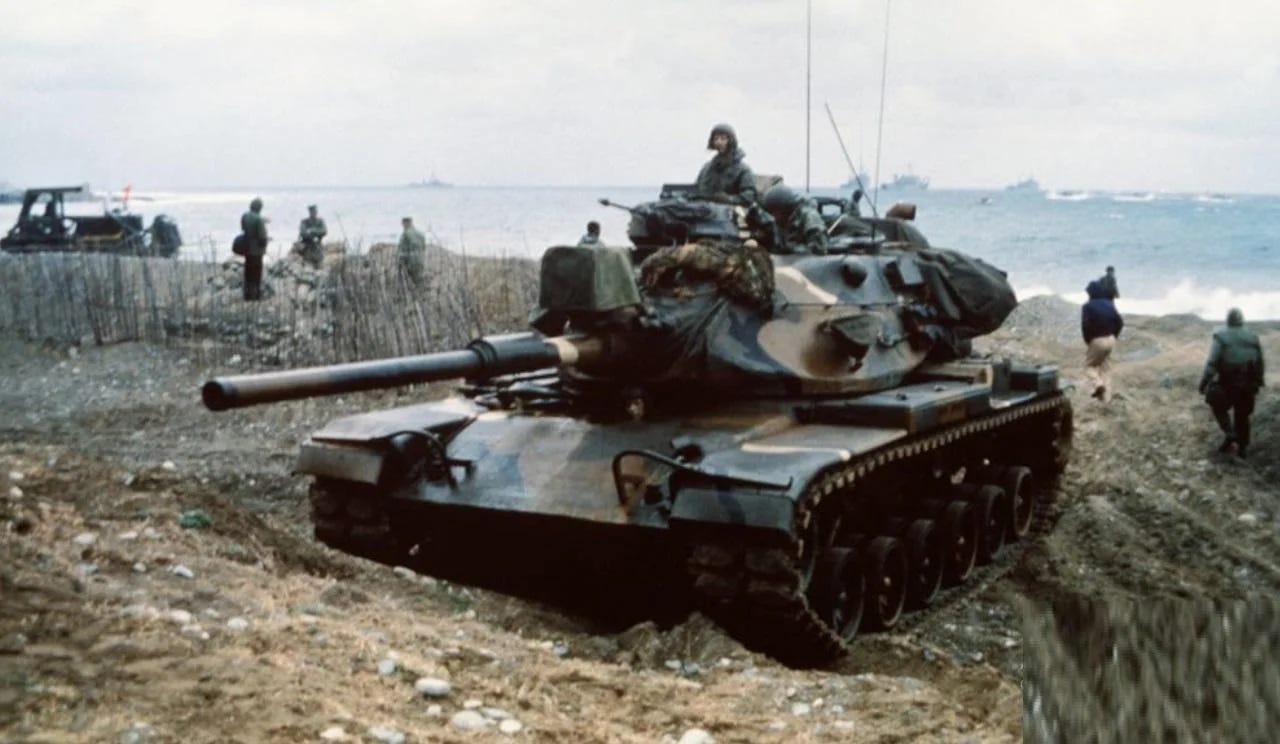
Day Four
By day four, the fronts began to shape up according to the original plan. The co-operation between the USAF and Army had sent the Pharaoh's plan of using the woods as easy cover down the drain, and now his major cities were left alone with shattered networks of CPNASA insurgents. Out of his 50,000 Machimoi, only 29,000 remained, many lost to the consistent U.S bombardments of his cities. His civilians, once numbering almost a million, now were left in pain, every single one conscripted to defend their homeland, their numbers destroyed. His tank fleet went to zero as the American Air force hunted every last vehicle down for free kills. His cities aflame, he chose to make his last stand with a sword and pistol in Aberdeen (New Cairo) with 12,000 of his men entrenched across the clustered city. Boucher and the Mantis pushed in on Bel-Air (Kom Ombo) early in the morning, and by noon, had defeated the 30,000 defenders, civilian and Machimoi alike, marching out every remaining civilian into the nearby farms and executing them in mass with the Ku Klux Klan detachment. It was pitiful, Imy-Ra Intef dying with his men during the action. The largest urban fight was over in ten hours, razing the formerly prosperous Maryland town to the ground from artillery and air bombardment before the Army went in and rounded up those survivors. It was so simple, for such an important act in American history - Boucher himself was melancholic, telling a war documentary crew riding along with the Mantis that “This is slaughter - a necessary, rightful, enjoyable slaughter, but a slaughter nonetheless. Someone should find me a uniform clean of nigger blood.” With the annihilation of Kom Ombo and the execution of the citizenry, the Pharaoh knew that he had two choices - Run to Edgewood and fight into the waters, or fight in his capital city. He chose the latter, preparing his palace for one last fight. The Machimoi were now completely shattered, and no matter how hard they fought, they were going to die. The first suicides were reported on this fourth day of operation, some Machimoi leaders immolating themselves to prevent the Klan from defiling their corpses (as was common at this point and well displayed). The fanatics continued to fight, in the woods and in the streets, down to their last bullet and then the bayonet. The end was not here yet, and the Pharaoh made one final public speech in New Cairo, in front of his pyramid, to remind his supporters that they were fighting for eternal glory, and that death would not be the end.
Day Five
Major Leon Boucher and Captain McGuire met at Blenheim Farm, finding each other for the first time after the invasion. The 2012 Film “The Boucher”, a biopic covering the life of Major Leon Boucher re-enacts this scene based on what McGuire has said. According to McGuire, the two first saw each other when McGuire was running artillerymen to a logistics meetup point to grab another set of munitions for their M109 howitzers. Shaking hands with his old friend, Boucher would wish to share his pack of cigars with the young McGuire, who would immediately smoke one while the M109s behind the two were loaded. The two would discuss the operation in short and simple phrases, something along the lines of it being no different from what they faced fighting the SRC. “Fanatics after fanatics, thinking they can take on America. The usual.” McGuire said to Boucher, who replied with “As much hatred as I hold for them, I hold more love for my homeland”. Boucher and McGuire would meet again at the farmhouse, where a mass execution of Machimoi prisoners and Pharoahdom civilians was ongoing behind them during the process of loading up new tanks for the attack on New Cairo. There, Boucher is reported to have confessed his plans to move his wife and children to Colorado. He would then jokingly tell McGuire a “thank you for the easy promotion to Colonel”, which McGuire would then insult him in response. Boucher doesn’t take it personally, telling McGuire to see him after the battle for New Cairo, telling him in earnest that he hoped Albert would hand them both the promotions they wanted and certainly deserved. The two men then parted ways, McGuire expecting to push down towards the Aberdeen Army proving grounds and fight the major Machimoi encampment there, while Leon would push his brigade directly into the hillside to secure road junctions and lay down fire on the city. Mantis would push from the west, and the Air Force was on call and available for every commander to call in bombing strikes. The Klan would push alongside the Mantis force this time instead of being behind it, the men yearning for even more glory in the annihilation of the final, real bastion of Pharoahdom resistance.
American artillery singled out specific defensive fortifications within the town, while the planes, as usual, went on area bombing runs. The aircraft used imprecise general purpose bombs - as many as they could carry - since everyone defending on the other side was to be considered hostile. Once the paths for approach were cleared and the Machimoi left wounded, the army rolled in. Mantis positioned his main tanks outside of the Mount Calvary Church, calling in additional air assets to clear the woods ahead for clear sightlines onto the city’s bordered expanse. New Cairo was well built up by the Pharaoh, and while most of it was now leveled, there were still concrete emplacements standing. For the first hour of combat, the Mantises simply fired until they saw movement stop. Once fire stopped from the I-95/Route 22 junction, Mantis led his armored personnel carriers to occupy the position and then poured his tanks down Aberdeen Hills. His Klan allies went north, focusing on sieging the Adam Heights - Where the Palace of the Pharaoh was located. At Paradise Road, the Mantis had his tanks take position and begin working their way slowly through the burning apartments and suburban homes, clearing it of all CPNASA members and soldiers. Many opted to abandon fighting positions and die fighting with their wives and children in their family homes. Mantis tanks put them all down the same, gunfire ripping through plywood doors, soldiers rummaging through piles of torn up single-stories to clear the place. Within four hours, Mantis had killed 6,000 - Men, women and children. One of his units went ahead towards the general hospital in Aberdeen Hills, a hospital constructed next to a concentration camp. One designed by the Pharaoh to provide a place for the mixed rape-children, where a hundred of them were kept in nurseries and incubators. Upon finding the horrid hospital, Mantis troops marched the CPNASA staff members out, shooting them all before dragging the infants out as well and tossing them in piles by the roadside. In the grass lay hundreds of infants, who were either killed by gunfire, blunt force trauma, or simply - officers opted to leave them to starve and perish in the elements. The hospital building itself was set on fire and used as “target practice” for an M60A3 tank attached to the unit, including the large bronze CPNASA coat of arms on the side wall facing towards the Pharaoh's palace.
Right after Mantis began to move in, Major Leon Boucher and McGuire did the same. On different sides of the hill, the two had to fight through similarly entrenched Machimoi surrounded by civilians, though at this point their number was getting fewer and fewer. Boucher had to wade through a marshy wooded area full of African refugees that took up arms with the Machimoi, and even some of the last Ethiopian-origin volunteers to remain fighting. A Machimoi Ra-1 was even present, destroying one of Boucher’s M113s and damaging Boucher’s own M60 tank, forcing him to switch to the role of an infantryman as he led the advance as the tanks got bogged down a mile out from their final capture point. Captain McGuire led his force down towards the military bases, facing significant resistance from conventional Machimoi forces. McGuire called in as many air assets as he could to take out the fortifications ahead of him, leaving Boucher’s force without helicopters. Leon would have to make do, his soldiers fighting it out in the streets of Aberdeen. Realizing his casualties, Leon moved up further into the frontline, taking the St. Joan of Arc Catholic Church as his command center. In the bombed out Church, Boucher had led his men to victory in the streets, only to be repulsed back by a final suicidal charge of over one-thousand Pharoahdom citizens carrying any weapon they could find. Boucher’s men ran back the street towards the Church, firing into the crowd as they tried to create distance between themselves and find cover. Realizing the situation, Boucher ran down to the front of the Church, picking up his grease gun and laying down fire to protect the men of Company A, the ones that were stuck on street level without cover. Lieutenant Lee Carter, the commander of Company A, reported that the Major’s presence in the surrounded unit bolstered morale significantly. He reports that the Major certainly got at least “seven darkies” with his grease gun in the firefight, the rest of his brigade spread out trying to push the enemy back into the kill zone. At the same time, McGuire had only captured Hartford Road, the road that had been the site of the CPNASA’s first victorious battle against government soldiers. His unit was to lead another assault, once a pair of F-4s completed their final bombing run with fuel-air-bombs onto the concentrated Machimoi defenders. McGuire recalls that, at the time his soldiers were watching the bombs explode, ducked down and waiting for the order to move forward, he felt a need to look towards the Church steeple of St. Joan’s. A devout Catholic, he was initially comforted by the presence of a large cross - but McGuire reported a tinge of regret, a palpable sense of confusion crossing his mind.
Lt. Lee Carter reports that while the brigade fought on in the suburb, the tide slowly turning against the weakened defenders, a soldier of the Company got hit and fell on a piece of rubble in the direct sight of Leon. The Major then got up at 4:12 PM, letting his submachine gun fall on his sling as he rushed to pull the young man to a safer position. As Leon ran, ordering a medical team over, a Machimoi sniper, hidden amongst the burning suburban homes, pulled the Major into his sights, the distinctive eyepatch over Leon’s injured eye catching the sniper’s attention. A 7.92x57mm Mauser rifle shot out from the window, cleanly slicing through the Major’s upper chest. In the next two minutes, the Major bled out as Lee came to his side. His last words were reportedly “Don’t help” and “Keep fighting”. Major Leon Boucher would then die in a pool of his own blood, in front of the Church’s steps. His hand closed into a fist, and his bright blue eyes stared open into the sky. The young man whom Leon moved to save ended up surviving his injury, a gunshot wound to the abdomen. With the death of their major, one would say that the soldiers lost all their mercy - if they had any to begin with. Every last soldier took it upon themselves to kill anyone of African descent they found in the destroyed waste of a town. In the next 2 hours, Aberdeen’s military bases were captured by McGuire and his companies, Lt. Lee led his men to victory in lower Aberdeen, and the Mantis ended the flame of rebellion in Aberdeen Hills.
The Klan had sieged the Palace, and making their way inside, had fought Machimoi elite after Machimoi elite. In the end, they had reached the Black Pharaoh’s personal residence, and there he was, his concubines and himself all armed with daggers and pistols. He ordered that the white-hoods give him a final, worthy fight like a real warrior deserves. A Klan member took upon the challenge, pulling out his families’ old confederate sword, fighting the Black Pharaoh in a battle of strength and wits, metal clanging upon metal, parries and swords chipping. In the end, the lone Klansmen successfully sliced the throat of the Black Pharaoh, and with his death, the last of the Machimoi in the palace shot themselves, and the few concubines not dead yet - fell on their knees in tears before stabbing themselves. Or so, that is what the legend says about the end of the Black Pharaoh’s life. The truth of the matter is, no corpse was ever recovered. Several Klansmen claimed that they held the Pharaoh’s skull for decades after the war, saying that they were the mythical ones to slay the beast, the ones to finally end the legacy of the Pharoahdom. What is known is that almost every CPNASA member and Machimoi soldier waiting inside that palace, fighting to defend their Pharaoh, ended up dying that very day, many in extremely gruesome fashion. The Palace’s flagpole held up high both a CSA and a USA flag flying equally by 9 P.M. With that, the battle for New Cairo was declared over, and stragglers were hunted down or lynched by the Allied forces. Most of the city was demolished by military engineers not too long after, and Aberdeen was rebuilt as it once was, simply in a smaller and more pre-planned way. A memorial for those killed in the battle fighting the Pharoahdom was included in the town square, and St. Joan’s Church, restored and rebuilt several times, leaves a memorial plaque by the entrance. “In Remembrance of MAJOR LEON BOUCHER, United States Army - 1951-1984.”
Day Six
The carnage was brought to a halt on day six. Edgewood fought to the last man, but the time for the CPNASA was up. Complaining at the U.N was expected, and even more unsurprising was the lack of anyone willing to sanction the United States over the situation. Houses burnt down one by one, the last CPNASA settlement was killed off in the same brutal way as the rest. With their Pharaoh dead, some Machimoi decided to drown themselves to avoid a more violent death at the hands of American soldiers. Some denied his death, others claimed he had simply transcended the current reality and went to the Kemetic heavens as a true warrior. In the end, no one was left standing. Either hanged or shot up, mass graves of a former civilizational hope became more of a chore to the conscripts left to fix this mess. The cleanup had begun, and with the woods being cleared of the last stragglers and those trying to hide out from the United States’ Wrath, the invasion was declared complete. Lost to the world, the CPNASA ceased to exist, their people perishing and their attempt at a civilization blown to pieces. American tanks now treaded where the Pharaoh once stood, tearing down his visage and his symbols everywhere they went. Now would simply be the fallout of the American civil war ahead of the greater population, the contention point of politics as the mentally fragmented nation put itself back together by the force of patriotic gunmen.
McGuire’s retelling of events following the victory at Aberdeen are quite contentious. Obviously made into a major motion picture, friends of the Mantis claim the supposed sequence of events shown in a specific scene were dramatizations, with dialogue changed to better fit the narrative that McGuire would write up post-war. Either way, according to McGuire, it took two more days until he was released from active duty, the Mantis Division pulling back due to the lack of any hostile threats in the area of operations. The only men who stayed behind in the wasteland were military policemen and army engineers starting the rebuilding process. McGuire flew on a Bell transport helicopter back to the York staging area, then recalled to the National Guard base outside of Trenton where the Mantis division would be receiving debrief from the General himself as planned previously. There, McGuire was able to take a shower, get into a clean uniform, and take a day of rest until the Mantis arrived to get everyone into formation. Allegedly, McGuire was called into the commander’s office, where Mantis held a private discussion with the Captain. Quoting McGuire, Albert Theodore had apparently begun talking about the CPNAS campaign, asking the Captain what he thought about the level of success achieved in the operation. When McGuire stated that he thought it was a fairly successfully executed plan, Albert began yelling at him about the number of men that died during the assault. Albert asks McGuire if he thinks the dead would agree with him, where McGuire responds with a “No Sir, they would not agree with me, Sir!”
Theodore then asks McGuire about the possibility of there being a missing officer at the debriefing ceremony. McGuire assumes this means him, and tells Theodore that it is up to him to decide whether he deserves a promotion or not. This is when Mantis delivers a harsh slap across McGuire’s face, and yells “Where is your Field Major, Captain? Why are you missing your superior officer?”
McGuire responds, lifting himself up, straightening his posture to face Albert - “Sir, I lost my major, sir!”
The Mantis shouts back, slapping McGuire across the other side of his face this time - “Why did you lose your Major, Captain? Did I order you to come back without a field major by your side?”
“Sir No Sir!” McGuire screams out, his face burning with anguish after receiving the two blows.
“Then why did you come back to this base without a field major?”
“Sir, he was killed in action, sir!”
“Was he killed in action, or did your failure to act get him killed?”
“Sir, I got him killed, sir!”
“Oh, that is exactly what I thought. You got your major killed. Guess what, you piece of Irish trash. You are now being promoted to Major. Does that make you happy, Major McGuire?”
“Sir, No, Sir!”
“Why doesn’t it fill you with joy and pride, Major McGuire, to earn a promotion from General Mantis himself? I better see you smile until New York City sinks under the waves after your promotion and distinguished service cross comes through. Now get out of my sight and get your bum-ass ready for your little ceremony.”
With that, McGuire was dismissed from the presence of the Mantis. In the upcoming debriefing ceremony, just as the Mantis had said to the young officer - he was promoted to the rank of Major, and received a distinguished service cross. Alongside this award, he also received other congratulatory medals for his service, including a “Pharoahdom Campaign” star specifically requested by Albert to be given out to every veteran involved in the invasion.
The ceremony was grandiose, a sterile beige room housing over two-thousand men, old and young, all dressed in freshly cleaned uniforms, all shaved and with clean haircuts. It contrasted with their experiences, their toughened faces, their scars and bruises. The Mantis took position at the rostrum, beginning with a speech as he always did, to the tired men sitting in the auditorium seats.
“The Mantis has fought according to what was needed from his country. The Mantis is proud of himself, but more importantly, he is proud of his children. The Mantis could not have done it without his people, the men of the Mantis brood. Honor, Integrity, Valor - These are all words that come to mind when we are asked to describe ourselves in front of the newspapers and television cameras. The truth is, we are all a bunch of insects in the grand scheme of things - Insects that bite off the heads of our awful enemies. We won by being more violent than the violent insurrections, and so the U.S Army makes medals for us to wear. I ask you now, that you humbly accept these commendations, if only to make my job easier. I don’t like formality any more than you do, and just like you, I have friends to bury. The important part of life may be lost on you, mentally or physically, but I ask that you at least return to whatever home you can have and keep these medals, keep your greens, as a memory. Not a memory of me, not a memory of the unit, but as a memory to those that gave their lives fighting with you, to those that made the ultimate sacrifice and crossed into the afterlife.”
At the end of this speech, Albert would start calling names out of a list, and pin medals on each one’s chest once they came up. Nobody hesitated, even if they were initially reluctant. Every single name walked up and accepted his award, at least for the sake of Theodore. From this point on, the Mantis division was officially discharged from duty and placed on standby. The civil war was over, and so with it, supposedly the unit that had fought through hell and back for America.
Part Ten - Shallow Waters
Following the victory against the CPNASA, the Mantis temporarily flew back to California. He spent three days in Los Angeles in between meetings, including a conversation held with his Naval counterpart, Admiral Eric Muskrat. Finally taking a secured car to Carlsbad, he cleared his schedule, retiring all his business to his aides, and simply spent time resting. No guards this time to bother him, he was actually detained by a Carlsbad Police Department officer eight days into his vacation for crashing a government-provided Ford Bronco into a highway post during a night of drinking. Recognizing the hero of the civil war, the police officer brought the injured man to a hospital, where Albert was discharged without any offenses eight days later, only having received a mild concussion and broken finger. He continued lounging on the beachfront property drinking away until the summer of 1984 ended. This is when, in early August, he received a particular phone call. The Department of Defense offered Mantis a new job. When the civil war was finished, the Mantis wanted to retire from active duty, now that the country no longer needed him. However, the highest ranking and most experienced General in the United States retiring would be a cataclysmic waste for the government. In response to this, the government decided to include a new military facility alongside the rebuilt version of Staten Island. “Albert Theodore Tank Training Facility” - a new military school, connected to the College of Staten Island for teaching tank warfare tactics and giving new officer cadets a place to practice their skill of commanding a tank platoon. With a six-figure salary, and the chance to leave a greater legacy for the future, Albert decided to take the chance, and agreed to become the school’s administrator, taking that it would free him from having to manage the Mantis division itself.
The Mantis division’s successor was supposed to be Major Leon Boucher himself, but without a man to promote, Mantis would remain the official leader of the Mantis Division (The newly formed 15th Armored Division, part of the Third Army Grouping for the II Corps) - but the unit would remain inactive, simply working on training missions along the East-Coast. America had to stop the wars and focus on rebuilding. With the completion of the tank training school in 1985, Mantis became Provost and began teaching to a group of 2,000 cadets, having a fleet of 40 M48 and M60 Patton tanks in the garage to practice drills and get the men experienced with how their tanks work. At the same time, Albert fought tooth and nail against the DoD’s wishes to arm the other two army groups and their tank divisions first, citing the previous agreements to give the Mantis Division the first M1A1 Abrams in active duty service. Eventually compromising, the First, Second, Third, Fourth, and Fifteenth Armored Divisions received M1A1 Abrams tanks in 1985, totaling around 1,118 M1 and M1A1 tanks total in active duty service by Christmas that year. The Mantis would participate in 5 division-wide exercises between 1985-1988, often seen riding the new M1 Abrams tanks, even into his older age. His academy would expand to include three separate training facilities across nearby states, and the Mantis Division would begin official duty again in 1987 as the United States looked to fortify their borders and hopefully reunite North America once again, ergo the Kenestik threat surrounding the world causing the other armored divisions to be stationed in newly independent Canada and Taiwan, the U.S territory of Mexico, the Republic of Vietnam, and even in Europe. Albert visited Greece in the summer of ‘86, harboring his heritage as a connection point to the local military commanders.
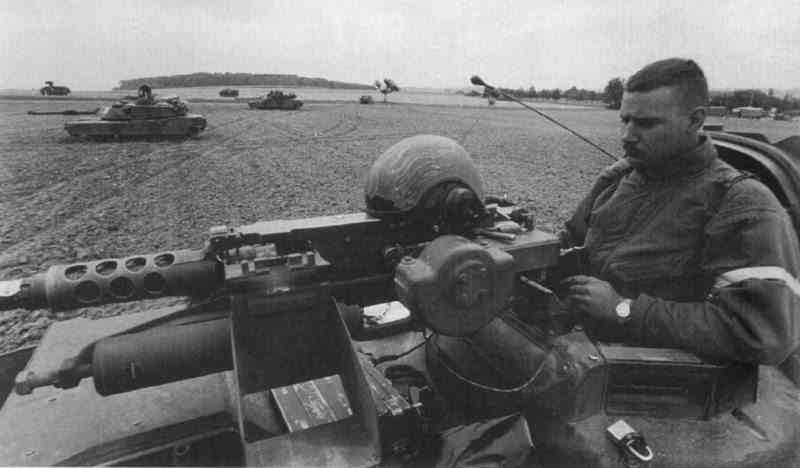
General Albert “The Mantis” Theodore, atop an M1A1 Tank, 1987.
In his personal time, Mantis was urged by friends to finally marry, “settle down” and buy himself a house in Staten Island (considering he had been sleeping inside his office the entire time). Most of his friends had married nurses and other volunteers during the war, and it was seen as “unlike a General” to not build a family for America. He tried to stay off of drinking, but his alcoholism couldn’t be curbed successfully for longer than a few days at best. Building a home in the suburbs closest to where he lived as a child with the money he had earned, the Mantis would inevitably end up rushing a marriage. A 25 year old Manhattan woman, Mary Fredrickson, whom Albert began dating after meeting her in a DoD office beside the world trade center, agreed to his proposal one night at “The Battery” park in New York. They officially hosted the wedding in a Lutheran Church in January of 1988, one attended by few of Mary’s friends but included dozens of men with battle scars, clad in Army greens. Mary in general had few connections, her direct family having died in the civil war. The only relationships she could form was with the wives of Mantis’ many army friends. This led to her clearly bottling up a lot of her emotions without anyone to talk to about them, another additional strain on the relationship.
While initially favorable to each other, their marriage was described as contentious later down the line as the Mantis was not only busied by his work at the military school, but Albert was also prone to fits of anger. Combined with the age difference and his overuse of Alcohol, it was a bad combination, but they ended up managing. Mary gave birth to twins, a son and daughter on October 6, 1988. Mantis had little time to take care of “Leona” and “Christopher”, busy with managing his school and associated divisional successors. Mary and Albert grew even colder in 1989, Mary accepting and confiding eventually in a personal letter to a friend of hers that she wouldn’t be able to spend time with Albert for more than a day per week due to him always running off drinking or teaching at the military college. Albert himself seldom spoke of his relationship with his wife, to the point some of his work partners did not even know he married well into his first anniversary. This distance between husband and wife, Theodore’s enjoyment of liquor and tanks, was a measured problem that would be exacerbated in scale on June 4th, 1989.
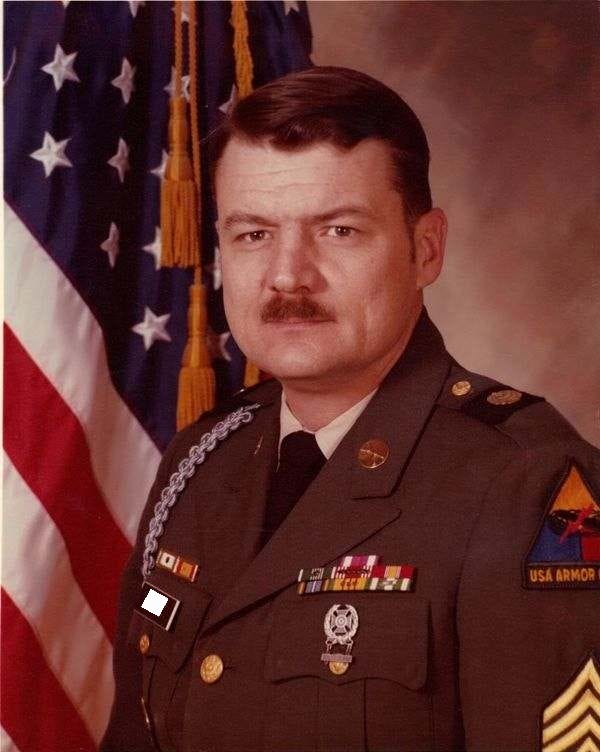
To be continued.